[00:00:01] Speaker A: Welcome to Crypto Talk Radio, the podcast for everyday investors like you. Visit us on the
[email protected] and now
[00:00:10] Speaker B: here's your host, Leister.
Thank you for that Bailey and welcome everybody out there in Crypto Talk radio
[email protected] amidst the world of suck crypto, I'm a little bit excited. We have a special guest today. I'm really excited to share this discussion with you because it's finally hearing refreshing information from not only inside crypto because he has been in crypto for a long time, but also from outside of it. He gives a very unique perspective and I answer questions to tap into total knowledge and he does speak at points. We talked about his organization and his alignment in crypto today, so that's going to be very exciting and I hopefully you'll hear the full duration of it because I'm really looking forward to hearing thoughts Crypto Talk fm. Let us know about what you think about the guest and everything. I also have a couple of news bits I'm going to be talking about. I will talk briefly, mostly bitcoin focused I think today, but I got a couple other tidbits also to cover.
Coinmarketcap.com we are going to zoom out to the month chart and we start with Bitcoin because bitcoin has some chatter as a recent due to some price surges that didn't last. But I think they're good to start out with on the month chart. Currently we're hovering just shy of 65,000 bucks. What I see as a downward trend some people see as an upward trend because there was some sell off of precious metals people theorize triggered by the Hormuz incident that's going on out there.
And something some think rather that money's going to start flowing back into cryptocurrency starting with bitcoin. And so they're testing levels to see if this is finally the surge that's needed now. Unfortunately there's a number of things working against it. One of them I'll get to here momentarily but we'll spin over to Ethereum. Ethereum, currently hovering just shy of the nineteen hundred dollar mark, had a much better trend upward and my guest actually talks about Ethereum, but Ethereum is believed to have a better recovery than Bitcoin overall, at least in the short term from what I see, because I do see a upward pattern for Ethereum that I do not see on Bitcoin, largely strengthened by ETFs on the main stage. And then idiot Vidlick and some of the things he was trying to push in terms of improvements for the chain overall. So big picture, short term, we've got some problems. Long term there's potential, but there's contingency. One of the main contingencies which I think is worth discussing is the Clarity Act. A while ago I said that I didn't feel as strong about the Clarity act as some of the YouTubers that are out there. And I said that I don't think this is going to move anywhere in the near future.
Well, the President Donald Trump recently came out and as he does, posted on his social media to press Congress to act because they're about to go on break.
And for those outside the US you may not have known, yes, our Congress actually goes on break at times. They just literally just, you know, stop working at points.
And it could be in the middle of a crisis, it could be in the middle of a budget crisis, it could be, it doesn't matter. They just go on break. It's actually in the law that they should.
Now, obviously that was built at a time when we weren't dealing with crises after crises and shut down the government and all these things. That was when that was created, was before.
So we never revisited it past that. And a lot of times because unfortunately, it's a two party system like it should not be. One party will use that as an excuse to kind of dip out and let something expire or let some law not pass or do some other shady business. That's the real of this. President Trump has been pushing to get the Clarity act over the finish line. The same Congress, by the way, essentially bum rushed the homeowners legislation that passed very recently that Donald Trump refused to sign.
And he refused to sign it because he felt it wasn't going to make a difference. And if you read the black letters of it, it's not really going to make a dent in home ownership and affordability.
The biggest thing in that one was institutional players. There's a cap on how many houses they can own for rent. They can't just buy up the supply. And they were trying to make it easier for people to build and lessen red tape in the process because that's all tied to affordability. But a lot of analysts believe it's not going to really make a dent in affordability.
It's not going further than it should. It's just bare basic enough. The biggest one is not letting large institutionals own significant amounts of properties. But you and, and some things that were proposed by those same analysts I emphatically disagree with. I don't agree with subsidies. I don't agree with these giveaway programs. That's not the right answer to me, things I would love to see that would help. Affordability. The price of wood is a joke. The price of siding is a joke. The price of building materials is a joke. The price of windows is a joke. Materials cost is a joke. Regulatory is a joke.
Things that we can't do without a permit is all a joke. Some of that's local, some of that's state. But the point is that there's so much red tape around homeownership, and all of that has its own costs that stack over top of it. That's the real problem. The other piece, and this was covered in another spot, was the government was trying to tell the banks, look, if we're talking to a house that's less than $100,000, like down in the south, some houses, I looked it up. One of my relatives, their house, when they. When they bought it, obviously was low, you know, five figures. But even just recently, it was only like 40, $50,000. And it wasn't like a small house in some places. They're just really affordable.
But what happens is that some of the banks are hesitant to lend when they're low amounts of money or if the, you know, the credit situation is the best. That also has an impact on home ownership and affordability, because if you're not able to get the loan, it impacts your ability to get the house. Right? Duh. So they're also the. When I say they, the White House, they're also trying to lighten up. It's like, banks, come on. I think Trump even signed an executive order about it. It's like, come on, get.
Okay, it's 100,000 lower. So what? Work with those people. We need to get more homeowners. And the truth is that these are viable homes that need to be bought up, that are available that nobody wants. But some of the lesser or the lower, you know, income folks, it's a starter home, or say somebody fresh out of college or high school or something, it's a starter home, and it's worth doing it, but we have to lessen the barrier, be able to get the loans. So the bottom line is that with the Clarity act, in addition to everything else, Donald Trump just, he's. He wants what he wants, and he's saying, this is what we need to focus on. China and many other countries, we like to take complete, total control. This major financial Happening as well as AI, where we're now leading, but where they're fighting hard. Don't let China win. Another subject, that's Trump. So he wants people to push on his agendas while he's over there, you know, pushing on war. And then the war is obviously suppressing prices and value and, you know, people are struggling and. But separate. Setting that aside, the point is that there's a bigger picture at play and there's a lot of puzzle pieces.
And the more he does not focus on the United States, the less it's going to get any better.
Now, without further ado, I'm going to introduce you to my guest here. We had a very spirited conversation, a very exciting conversation. I hope you do enjoy all the conversation points and pieces that we have. He does give information on where to learn a little bit more about it. I do encourage you learn a little bit more about it. I will tell you this is, this organization is going through a lot of shifts right now, and there's a lot of reorganization that's happening. That sounds very compelling. I have not gone deep into it, but I did go and take a look at the surface of what's going on. I encourage you to do so as well. You're going to see things that may be of concern.
I want you to listen to him because what he's saying, it's. It sounds like it's part of a larger strategy and part of a larger plan. And most importantly, you have to give respect to somebody, a CEO, that's willing to come on the show Crypto Talk fm, and just chat it out and answer questions candidly. And he is open and candid about the questions that I targeted because I was trying to simply say, let's learn about you. Let's learn about your background, let's leverage your knowledge, the history of what got us here. And then let's learn about your organization and where it's going, and let's focus on those directions.
I also challenge, because there may be people listening to the show that are listeners from other such projects, I challenge you to compare my next guest against other CEOs. And you'll understand when I say this is. This is what it should be. When I say wants to smoke, this is what I mean. Somebody that wants to openly have that conversation and answer any question put forth to them. And there's less chaos, obviously, now with this than with others, certainly. And my guest refers to that as well. He talks about how some of these other projects are treated, you know, like a poly market or Something that's true there.
It's a wild west, certainly, but it's also gambling. You're rolling the dice on a lot of them. And he draws a very clear separation.
He does that because he understands that there are projects out there like that. And he also knows the perception and how he has to work hard to reframe and what he's got to talk about, I think you're going to find extremely fascinating.
[00:10:05] Speaker C: All right, we're live and active. Jason, thank you for joining us here on the show. I appreciate having you. I'd like to start out by instead of me introducing you, let's have you introduce yourself, give a little bit of background, the company and organization you represent, and then we'll kind of jump right into it.
[00:10:24] Speaker A: Thanks for having me here. I'm really excited.
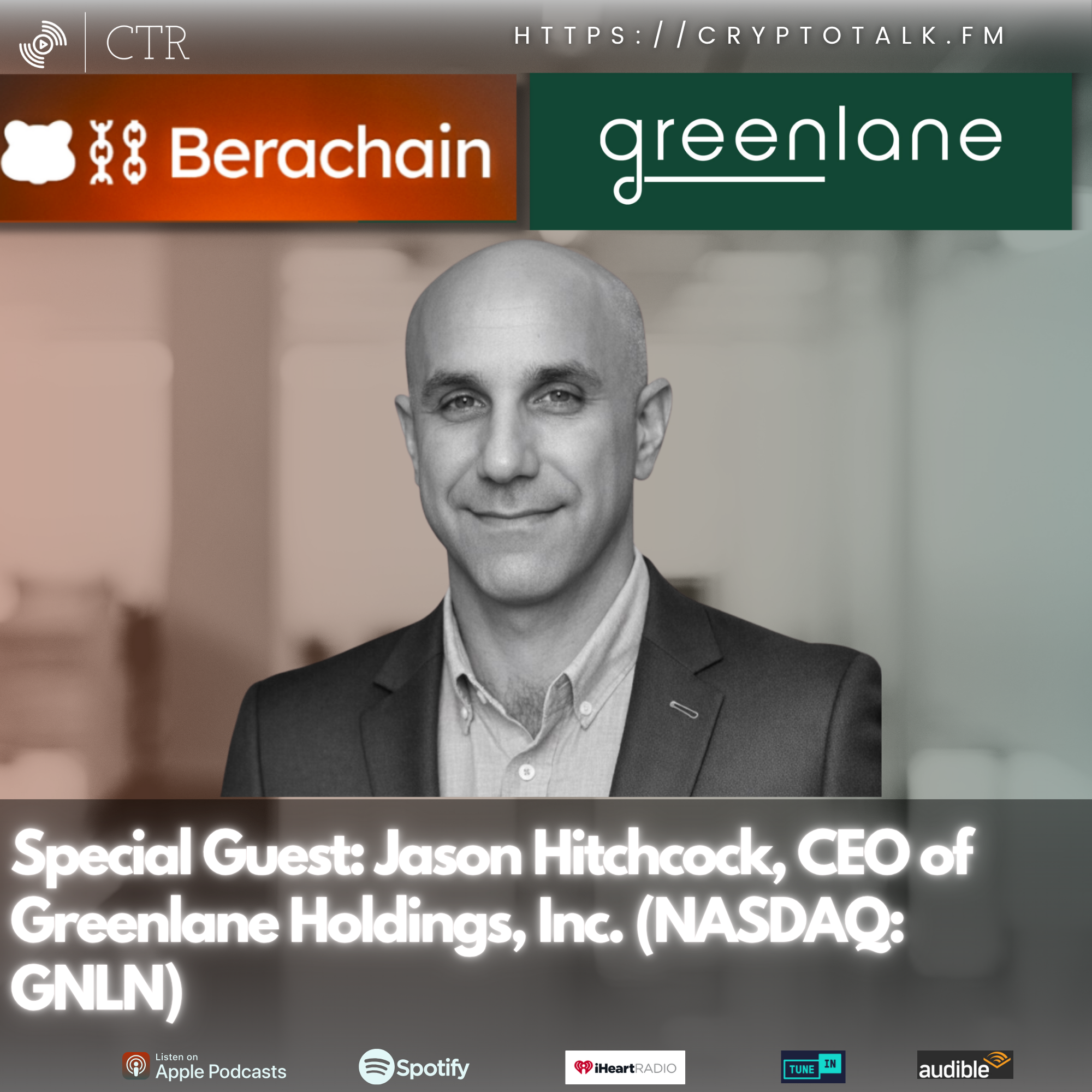
So I'm Jason Hitchcock. I'm the CEO of Green Lane, which is a digital asset treasury that has a sharp focus on accumulating the bar token, which is the token of bar chain, a layer one that was founded in 2025. Our mission is to accumulate as much as possible.
We're excited about the strategy.
My background though, for the last 15 years, I've been working in startup land, building out business teams and go to market teams for lots of different types of companies.
I've worked at a venture studio where we made a ton of different products. One we sold to Twitch where I worked for a few years. That's where I got super excited about Ethereum during Defi summer. That's like a period that fondly in the industry we refer to when a lot of different decentralized finance applications were coming out. Things like Unis, Swap, Curve, Compound.
There were all sorts of different products that made everyone a light bulb go off in a lot of people's heads. And for me, that's when I looked at crypto. It was no longer just coins that had prices that went up and down. I, I, I realized, oh my gosh, you can build applications on the blockchain. That's so interesting. That makes sense.
And I started a liquid token fund invested across Defi. Did really well.
Ended up wanting to get deeper into the industry.
Led a business team at Third Web where I sold commercial software for developing on chain applications all across the industry.
And when I was looking for what I wanted to do next, that's when I connected with the Barachain team. They were looking for someone who had experience managing a Defi portfolio and could evangelize the blockchain as the future for applications as a, as a platform to be the CEO of Greenlane. And I thought that's an exciting opportunity. So that's when I joined in January.
And ever since then we have been rolling out a digital asset treasury strategy.
[00:12:27] Speaker B: Awesome. I want to question a couple of
[00:12:30] Speaker C: things that you called out there because they're fascinating to me.
So the error that you refer to, I affectionately refer to as the wah wah west of crypto. Because we're also talking about a time when nobody really understood what was going to be.
We just were kind of trying stuff to see what might stick or what might not stick. Especially when you talk about curve, curve in particular with all the, with the evolution of defy. So we now have what I would argue is a saturation of it, which isn't necessarily a bad thing, but it also makes it difficult for new people to get in because they don't really know how to start.
They're struggling with, well, where do. Okay, there's a lot stuff here.
I heard something about this. Where do I get started to those folks, what would be the advice if somebody just, they're just completely lost, they don't even know where to start. They don't know Ethereum, they know Bitcoin, maybe they don't know about bridges, they don't know about swaps, they don't even know about exchanges.
And not just getting them on board, but to allay their confusion, to get them comfortable, what would you recommend? How would you talk them through that?
[00:13:42] Speaker A: That's a really good question. And the context makes a lot of sense. Like there's a lot of blockchains, there's sort of similar looking ecosystems on each blockchain.
I think the person that you're talking about, like who the person who knows Bitcoin, but they're curious or less familiar with Ethereum and where do they get started?
I think it comes down to what are they? What is their goal, what are they ultimately, what are they understanding things towards? Is it, hey, I was early on or I missed out on bitcoin, but I want to like, I want more crypto exposure. But it all seems kind of complicated.
Is it? I have some crypto and I want to earn yield. I've been hearing about yield. Like what is yield? Where does it come from? What are the different types of yield and emissions?
Like these could be the types of questions. So for someone who wants to like learn more, I think I would get clear on like what my questions are. And so for example, let's say, you know, the, the way to think about Ethereum, you know, we're hearing about all these apps. You know, when Bitcoin first came out, it was really in tech, what we refer to as a, like a minimum viable product. If you think about like, what is a decentralized computer, you know, right now, like Eric, if you want to have a website, you're going to have hosting on an, you're going to have an app, it's going to store data on an AWS or Google cloud server and nobody else really has access to it. A company owns that database.
Then Ethereum or then Bitcoin said, hey, we're going to have a public database. All these computers, these miners are going to run the software, they're going to notarize transactions, and it's going to be a public database that no one owns and you can send value around. And that's where Bitcoin really proved that a decentralized computer works. And it was super simple. It could do addition and subtraction. That's how I think about it. And then Ethereum came out and said, hey, what if we added programmability onto this, this blockchain? So not only can you can send value around, but we can have apps running on top. But it's still an immutable, decentralized computer.
And I think that's like the big, that's been like the step evolution.
And so then this time that that came out, we had Defi summer. So people said, what if we could run a lending market on this computer? What if we could run an exchange on this computer? And we started to like, experiment and, and throw spaghetti at the wall with like, what ideas benefit from a decentralized computer? And that's where I think we saw the strongest product market fit was with decentralized finance. A lot of other things were thrown at the computer. Like we had Web3 gaming, there were some different types of consumer verticals, meme, coins, et cetera. And it seems like a lot of things kind of came and went.
Not so different than like the Internet boom and bust that happened in like the early 2000s, late late 90s.
And it's entirely possible a lot of those ideas reemerge and like they were directionally correct, but maybe they were too early. Like when the Internet bubble happened, There were only 50 million people using the Internet.
Webvan, you know, went bust. But now Instacart is a huge company and so some of the ideas might be right.
DeFi, though, seems to have product market fit. And so that's where, like, I think people who are trying to learn more should Learn about defi. How are stable. How do stablecoins work? Stablecoins seem to be taking off at an incredible rate. Stanley Druckenmiller says He believes in 15 years, all money will be stable coins. You have the CEO of, like, Western Union talking about how they want to adopt stable coins across all their products. And so, like, learning about, like, what are the different types of stablecoins and how they work, what types of decentralized finance protocols create them? Can you get exposure to those?
Then you have exchanges, like we mentioned, Curve and Uniswap, where stable coins get swapped.
So my journey was just about learning about how these different types of products work. Lending Dexes stable coins, what protocols seem to have pioneered them and are the biggest.
And, you know, are there ways to get exposure to them that makes sense. What do people say about them? And then you can kind of follow the trend along the way and kind of develop your own hypothesis.
[00:18:03] Speaker C: So I want to now do the devil's advocate question.
You call out stable coins.
An argument can be made that stable coins and decentralization are inherently contradictory.
If you have an authority that can restrict the use of the stable coins, which is part of the kind of compromise that's being negotiated, is if we do that, we need to lock it down, freeze assets, take assets. So then it forms a form of centralization because it's controlled, which defeats what Bitcoin's intent was, which has caused recent conversations steering back to Bitcoin as, remember, this is still here.
It's. You can't control Bitcoin. It's not. That's what we want. We want something that's not controlled.
Then the counter argument to that is, well, yeah, but fraud. There's fraud, there's all sorts of criminal behaviors where crypto could be misused, which then creates a counter. You can misuse fiat. It's the same thing. Now you have an impasse. You've got this side that says Bitcoin's really what we need to be focused on. Not stable coins, not these assets, not these classes, not turning it into finance, but Bitcoin. This was always the vision. And by doing, basically turning it into fiat, you're going to lose the control that adds the value in the first place. To which, how do you. What do you say to both sides? Which is, I think they're both right in their own ways. But I'd like to get your. Your opinion on it.
[00:19:31] Speaker A: Yeah, I'll speak to a few things you said because I think that you laid it out really well. Sort of like a view of what's happening. So if going back, Bitcoin is what I described earlier as a very successful experiment with a minimum viable product. You know, can we create a decentralized computer with a single asset on it? Bitcoin that you can send around and it has its own economics and functionally it's become gold. Right. Like we have created a digital precious, you know, commodity and that's what Bitcoin is. I would describe that as like it's an application. It is. Bitcoin is the single application on that computer. That operating system can run just Bitcoin.
[00:20:16] Speaker C: Yep.
[00:20:17] Speaker A: Ethereum said we're going to take the similar computer, we're going to add more programmability and so now we can build other types of applications. And now we have a spectrum here where you have a blockchain that has a similar level of decentralization. You know, you can kind of debate these things about like validator size, etc. But let's assume it's quite decentralized and you can run, you can deploy immutable self running software onto it.
And now this is where we have different degrees of decentralization. Some of these apps are going to be completely decentralized. You can deploy like smart contracts that nobody can touch. Everyone can see how the code works.
And yeah, they're completely decentralized. Other companies though, like a circle, they could deploy their own contracts and they could have some controls over them.
And so I would argue that what Ethereum and other Proof of Stake Networks and Barachain and other blockchains have introduced is the ability for everyone to decide how they want to leverage decentralization and to what degrees and where in the stack in the value chain of their application does decentralization matter.
And so there are some services where it's vital for that service to run.
Products like AAVE and Uniswap.
It's core that the lending markets themselves, the markets that facilitate the tokens are completely decentralized. Now they support a full range of assets. Some of those assets, you know, there might be some gold backed stablecoin out there and somewhere someone's gotta like hold the golds and very, you know, there, there might be a centralized actor that has a trust assumption, you know, baked into them, but they're able to put that coin in the lending market.
So I would just say it's a spectrum, it's not an all or nothing thing.
[00:22:27] Speaker C: Fair.
So then enforcement, to that point enforcement becomes so now again I'm, I'm layman investor I'm, I'm skilled in investing, but not crypto. In the questions I'm asking, I'm asking. So in what you're referring to as a real world asset connection, obviously the asset has to exist, the asset has to be robust, the asset has to be maintained, the asset has to be audited. There's a certain rigor that has to apply to the real world assets underneath it. How can that investor that's happening if they just go to a uniswap, they don't know that all that's happening. So they got to go and do some research to make sure that this is a viable asset that's worth the time.
I think you can appreciate the significant, the sheer number of assets that's out there.
It starts to be overwhelming. For Newers.
It's not like on the stock, you just basically pull the prospectus and it tells you what you need to know if you care. If you go to a fidelity, they'll tell you right on the screen. My sense is that crypto doesn't do a good enough job pushing, pushing that information up to the investor to make an informed decision.
What would you say is a way to solve that, the information gap? Because what you're talking about is that the platform should be basically separate from what's going on with the asset. The asset still has to have its rigor. The platform is just a platform that's serving whatever and has no part in the secondary. But the platform, because it's separate is not feeding the information to the investor. And that may be, it's too much effort to go and have to find this stuff to be assured they're not going to get ripped off. And I'd like to get your thoughts on how can we bridge that knowledge gap to make it easier, lower the barrier of entry?
[00:24:09] Speaker A: Well, over time, you know, one of the properties of crypto that is interesting is that it has tokens. So we talked earlier about like this big decentralized computer that's kind of like the phenomenon of the blockchain. And a unique property of the blockchain is tokens which allow people to, you can transact in them. And so it's interesting in that every idea, every startup essentially has a token in crypto. And if you compare that to public markets, most startups, maybe they raise equity and a small group of investors is able to get access to it.
And startups go through mega cycles where most startups fail. And so however those, the, the failure is kind of narrowed. It's, it's felt by Like a small group of startup investor people.
Because crypto has tokens that are widely available to the public, everyone has the ability to get exposure to crypto startups. And, and so that's why there's so much sentiment like of ups and downs where the public widely feels the failures of like a normal failure rate of a startup ecosystem is more broadly felt because we can buy tokens. And I like that's the underlying feeling of how can I do better research? And boy, it seems like there's a lot of things that don't work. And that's just the case with startups in general. Most startups don't work, but because there's tokens we are more broadly exposed to that.
And since I think Defi Summer we've had and we've had like the rise of like crypto start on chain startups, decentralized finance companies, there's many in the category, we have other verticals like decentralized physical infrastructure, etc.
We're seeing more tools emerge like that gather on chain data to kind of compile metrics that the industry is gravitating around and we find interesting. Like I think there's a really great website called Defi Llama that I love to use. It'll show you the total value locked on a blockchain. You can see if tokens earn fees from the business itself.
How much do they capture in fees? Is that shared with the token holders?
You can see how many token holders there are and you can kind of decide what mix of metrics signal to you that this business has traction, is making progress, is healthy, is compelling and you know, it at least gives you more of the story. Like is it even on Defi Llama?
[00:26:54] Speaker C: Would you feel that people should largely.
I don't want to say it this way, but I don't have a different way to say it should largely disregard social media when looking for projects.
[00:27:05] Speaker A: I think it's a place to learn about a concept. I think it should only be one input. And you know, I think every investor needs to think about what their own risk tolerances and how they form opinions about companies. Like if you were to remove Imagine crypto never existed.
How do you make decisions on what company stocks to buy? You know what, what is it that gets you to buy an Apple stock or a Tesla?
What sets of narratives need to form in your head and get you to conviction? What information do you need to see?
[00:27:42] Speaker C: Well, and there's one key difference. I wanted that. I'm going with it.
Let's Take a, let's take Apple stock. There was a time Apple was nothing more than dying stores and malls with a sad looking guy when it was on the verge of bankruptcy. And then Steve Jobs is called back in and we know the story and its stock was rock bottom. The difference is we're talking fully known people, we're talking regulatory scrutiny over the business, we're talking financials that are audited, we're talking a trail that we can track. People. There's so much regulatory oversight on that market that it gives a little bit of a cushion where the crypto projects don't have that upfront because they don't. There is no structure to do it upfront. We heard the story under the prior administration where yeah, we tried to go in and register with the sec. They wouldn't even do our application so we can't get registered. Then you have a slice of these orgs where they are shady on purpose and because there's no regulatory oversight, they're trying to slip something out there just to get quick money pump and dumps and then trying to distinguish what's really a pump and dump versus something that's viable. And many of them that don't put that, they don't front their own equity. However they get it, loans or otherwise, they don't do it. They're using this pre sale strategy which some people say if it's a pre sale it's probably a scam. Well then that's not fair to the smaller orgs you're talking about where they are legitimate but they have no other way to raise the assets for what they think is a good idea.
Then there's, they get a startup, they get a good idea, it gets to a point they learn something that says this isn't going to work, the laws changed, we're not going to be able to make this and they have to shut down.
So where I'm kind of going is simply to say on the stock market side there's so much cover. On a government side there's so much cover and awareness. It's harder for them to rip you off. It's not impossible, but it's much harder to do than the crypto side and the newer investors now versus say 2021, I think you were watching in 2021, it was just, it was chaos of just dog coins and all these crazy things and news articles. This person turned $80 into $2 million. That gets people trapped.
I'd like to, I'd like to see if there's some solution to that maybe there's not.
[00:30:02] Speaker A: Well, there's an aspect of crypto that reminds me of like you know, Polymarket betting or DraftKings where people see a couple signals like oh, here's a thing that is quite obviously super early and, and it's in a category that, you know, it's like a lottery ticket, like it's a meme coin or it has the characteristics of it. And I think people should put that whole concept in its own bucket of like gambling.
And then there's like another bucket which is. Are you like, are there startup like almost like startup investing where you have, you know, if you look like Blockworks for example, has a whole dashboard on like a transparency report and there's like a number of companies that report all sorts of metrics about their companies to it. And it's really interesting and you can browse these growing startups that you know are reporting revenue and all sorts of metrics that you, you were talking about, about public stocks. But it's like a self imposed industry mechanism. It's not coming from the top yet because we don't have like the Clarity act passed or other regulation. But the industry is trying to, you know, put out metrics so that people can understand what startups have, you know, what companies have. Lindy, you know, how much revenue are they generating per year, how much of that revenue goes to token holders, you know, what venues are these tokens traded on. And we want to get a sense of as much transparency as possible. The blockchain does lend itself to providing some degree of interesting transparency, but it also needs to be, you know, caveat. So I think for, for people that are looking for exposure, that's why I said earlier it's about like learning about, I think, you know, what, what is, what is defi. Like you have like I said, stablecoins, you have lending markets, you have dexs, you have perp dexs. You have a variety of categories that are clearly emerging as industries that have product market fit. And then the question an investor can ask is, well, if this has product market fit, is there, is it like a winner take all category? Is it like a winner take some? Who are the sum? Who could be the winner take all?
How well is the winner doing right now? And try to imagine like where could this go? And those are the ways you could build a thesis for something that you want to invest in more long term versus like a get rich quick you want like I sort of take a long term view on all investing. I don't, I think about equities you know, who's got a great long term story building on big mega narratives, you know, Nvidia and Paler and you know, Tesla and SpaceX. Like these are going on in my view, like they could be examples that are playing on big mega trends in crypto. It's like if we take the assumption that finance is coming on chain and finance is being disrupted by certain types of startups, certain categories of startups that are on chain, like I mentioned, stablecoins, lending perp, Dexs, et cetera.
How if you know tokenization of assets, who benefits from finance coming on chain that provides these services? These are the types of questions people can ask themselves and they can like look forward and where, where could growth be?
[00:33:32] Speaker C: Awesome. Let's talk about Green Lane holdings because it connects in a very, I think appropriate way to this conversation.
Green Lane, from what I understand it started as cannabis based. Is that accurate?
[00:33:48] Speaker A: Yeah, it, in a previous iteration of the company, it was a cannabis accessories company that I would say it wrote like the boom and the bust of the cannabis industry which, which went parabolic and then came back down to earth.
And then in 2020, late 2025, there was a phenomenon where a number of blockchains were searching to create public vehicles to create exposure for them. There was a wave where Michael Sailor and Bit and Tom Lee from bitmind had demonstrated that a crypto treasury could become a proxy for an asset. Yeah, and these are really interesting vehicles. And so other blockchains started launching digital asset treasuries. Bar chain raised a pipe from its investors and like they also put into the pipe a large portion of their own tokens from their treasury that were locked. And they did a reverse merger and took over the took over Green Lane, brought in their own board and they established Green Lane to go in a new direction of having a digital asset treasury where it started off with 50 million tokens and some cash. And the strategy is to accumulate more tokens, put those tokens to work on validators and do defi market operations to earn yield and then use that yield to operate the business and acquire more tokens. And it is a long term accumulation strategy that is designed to amplify the story of Barachain and also earn a portion of the revenue of that ecosystem.
[00:35:34] Speaker C: And then February, this is where I want you to clarify. February is when basically you were put in charge of specifically the bear chain asset Treasury. The strategy behind that is that date accurate. And then talk about what that means kind of what, what is the expectation under, under that assignment.
[00:35:55] Speaker A: Yeah, so when they, when they raised this pipe and they did the transaction to become a, you know, with, with the pipe and Green Lane In October of 2025, they spent a few months searching for a CEO.
They were doing the transition because Greenlane had a legacy business that had to wind down. And so during that period they did their CEO search. They then brought me in. We talked earlier about my background. You know, ran a defi fund investor in, you know, angel investor in a lot of different defi companies. I've run a infrastructure team at a Web3 developer tool startup, Third Web. I have a lot of familiarity with the space and so it brought me in to help steward the strategy. We have a team that is allocating into Barra. We do it on a certain cadence. We needed to do market investor relations and also coordinate with the ecosystem. How can we help tell their story?
How can we help investors better understand what's going on and the progress being made in the bear chain ecosystem? You know that that is my main role here at Green Lane.
[00:37:09] Speaker C: April. So I'm going timeline on purpose because I think it's, I think it's helpful for listers. So April reverse stock split. Is the date accurate for that? And then the reason for it was NASDAQ primarily compliance.
Okay.
[00:37:27] Speaker A: Yes, go ahead.
Yes. So something that happened when we acquired Green Lane.
What, what often happens is, you know, the market is still trying to understand, like what does your company do?
Before we were a cannabis accessories company that was kind of drifting downward and heading towards a NASDAQ minimum bid compliance threshold. If you trade below a dollar for a certain amount of time, you get put on notice.
And so this is something that's quite common with digital asset treasuries where they take over kind of like a certain type of company and like they go through this process where when you do a reverse share split, it then consolidates your shares and you end up shooting back above a dollar and getting out of compliance. And that's what happened to us. So it was a defensive move.
[00:38:20] Speaker C: I know that happened with the, the high speed.
Supposed to be the high speed train, California and Nevada that happened with that company. They did it like twice and it was being traded as penny stocks. And so they kept doing reverse splits over top of it. Eventually said this is never going to happen. I think that was like six or seven years ago and they still haven't made any progress. That's why I was familiar when you, when you started talking about that one.
Okay.
Validators were involved with this process.
So as you're building this out and you're framing this and structuring it. You're in, you're keeping in the loop with validators. So they're part of the, they're part of the process because ultimately the chain, the integrity of the chain, the strength of the chain, the performance of the chain, as well as the decentralization we were talking about still has to be maintained during the process, but it also becomes a strength because it. You're purposely showing. We're not just working off in a vacuum in the corner. The validators are part of this journey to build this forward and make this successful.
Did I capture that accurately?
[00:39:23] Speaker A: Yeah, absolutely. We run our own validator infrastructure and we also deposit onto other partner ecosystem validators. And you know, we just think it's important to operate this infrastructure. It's. We want to be a part of the ecosystem. We don't get involved in any governance.
But yeah, we're right there participating with everybody.
[00:39:45] Speaker C: The big success story is that basically NASDAQ said we're good, this looks good, compliance is where we need it to be.
There are agreements that I don't want to go details because they're not directly in part of this, but if you want to talk about it, please do. But I want to make sure I get through the timeline in total because I think it's a good story for people to hear.
So in May. So now this is standard and now we're in the real world outside of crypto. Maybe we take a look at it. Numbers are now realigning. Things are kind of getting reset according to this new. And there's going to be a little bit of pain. Down, up, down, up, down, up, down.
My question is everything seems to be reasonably stable. From what I can tell of the money movements. I don't see significant money movements given what's all going on.
I don't see anything that's, that's a concern as an investor is what I'm getting at.
It's normal when you're, when you're, you're getting everything realigned off. This type of, this is a huge transition. It's completely different business model in part. And a lot of those fail when you try to do a complete shift like this.
So it's understood that there's going to be some kind of disruption. July it was reported a head count sh the physical. So this goes kind of probably back to the cannabis organizational. There's different physical asset. Things need to be reassigned.
If we are doing any sort of commerce, we're going to do drop ships. So you're realigning the business into now this new world.
Question for this. Is there anything around the operationals and the staffing and the physical asset changes that was not connected to the cannabis wind down?
[00:41:22] Speaker A: No, no, not at all. So you know Greenlane had an extensive warehouse manufacturing and distribution business.
It was capital intensive. And so ever since the transaction to set up the digital asset treasury, we have been realigning that business.
Winding down warehouses, winding down, anything that, so that we could convert that into a very asset light dropshipping business.
It's important that we maintain an operating business that's, that's, that's almost a requirement when you do these transactions. And so we've been minimizing the costs on that side so that we could free up all the capital that we have to be redirected towards the digital asset treasury. And so we try to keep the market updated on the progress that we're making there because it's substantial and it says one, we're getting our costs under control as really quickly and then we're freeing up the capital for our core mission which is acquiring more Barra and that that's our main focus.
[00:42:36] Speaker C: Talk to me about Pol next.
Yes, from I've seen but and I get a high level of what it's describing but I would like to hear it in your words of exactly what is it and then how does it benefit the investor?
[00:42:49] Speaker A: Yeah. So a good way to think about Pol next is understanding. Understanding like how Barachain actually works.
[00:42:55] Speaker C: Yeah.
[00:42:56] Speaker A: What makes Barachain unique among many blockchains? There's many blockchains and they all, you know, some will say we are a super fast chain or a super cheap chain or we're private or we're four corporations and you know, they're all incrementally different from Ethereum or Solana in some way.
Barachain is compelling. It has something that is very unique in the whole industry.
I haven't seen another chain do this Bear chain is not just a faucet of tokens that it emits tokens to pay validators just to secure the chain. It has a unique thing called protocol owned liquidity Pol where a significant portion of the tokens that it emits are directed by validators to startups building on the chain. So the chain offers chain level financing to startups and then those startups who use those tokens to subsidize different markets, they might be defi protocols and they subsidize rates to make liquid to make it More attractive for providing liquidity, they can attract more tvl. As these startups earn revenue, they share that revenue back to token holders. So there is a loop here where Chain emits tokens to secure the blockchain.
The blockchain directs additional tokens to go to startups. Those startups then grow and earn revenue and they send a portion of their revenue to token holders. And that is something that makes Bear Chain unique. The Pol Next update was a update on the token design. Where previously they had multiple tokens and they consolidated, they simplified their token model into one. It was previously a more complicated.
The diagram I just described was a little bit more complicated. Now it's extremely simple.
And the other thing that they announced was a partnership program.
And the way I'll describe this is previously most blockchains were just passive platforms. They all said, we're going to be the next Linux of the blockchain. Here's our documentation. We offer grants, we have a Devrel team. We're going to do hackathons, come to us, join our discord, we'll help you build.
And many chains did this. And what ends up coming out of that is you have mercenary builders and mercenary capital. They come show up, they get a grant, they build a company and then when the money runs out, they kind of move their app to another blockchain. And we've seen this play out over the last few years.
Parachain announced a program called era, a part of Pol Next where they said, hey, if you're an entrepreneur, there's so many. There's a Cambrian explosion of startups being built right now. But entrepreneurs need capital. That's something that they need help with and they also need engineering support.
So if you can partner with us, we are going to partner with you. Bar chain being the we, and we're going to give you a dedicated stream of emissions from our protocol.
And you're going to use that to finance your startup. Think of it like debt financing.
You're going to pay these emissions back. You're going to have an agreement with us in 6, 12, 18, 24 months. For every dollar we give you, you're going to pay $1.20 or more back. You know, there's going to be interest on that. You're also going to code into your contracts a revenue share with token holders so that in perpetuity, as we help you grow, you're going to share revenue to our token holders and we're going to provide you engineering support, help you recruit liquidity, we're going to help you get visibility in the ecosystem and so it sort of becomes like a joint venture. And the reason why Bear Chain is doing this is they want to be really intentional about finding companies that you can't just copy paste onto other chains. And they want to help serious entrepreneurs grow. And what this ends up doing is the Bear Token ends up becoming sort of like an index of the whole blockchain.
Bar Chain is not trying to be like the next Linux, it's trying to be more like a, an index of a house of brands that are all growing and they all share revenue back to the token holder. And Barachain's mechanisms play an important role in accelerating the growth of each of these companies. And if they were to leave the blockchain, it just, the mechanism wouldn't be there and they would not be as advantaged. So there's a lot of alignment between the token holders, the startups and the blockchain itself.
[00:47:28] Speaker C: It's interesting what you're describing because bear chain was 2025 when it went live. Is that accurate?
[00:47:35] Speaker A: Yeah, yeah.
[00:47:35] Speaker C: So in 2023, I believe there's a project that still exists called Cult Dao.
Its model is described very similar to what you're describing.
Okay, but I don't, what's weird to me is because if I don't know if they took from somebody else, that I don't know. But the description is very similar.
There's the stakers, the validators, there's tokens, there's projects, come to us, we'll help, everything else is the same.
It didn't.
[00:48:15] Speaker B: From what I can tell, it wasn't
[00:48:16] Speaker C: successful in what it was trying to do.
They used kind of a form of viral marketing. You know, take these stickers and put them on booths and everywhere. So people are aware of us and
[00:48:26] Speaker B: we're kind of out there.
[00:48:27] Speaker C: Sureness and knowledge out there.
Can you talk about how what people may not be aware of what Bear Chain is.
I know the 2025, but that's all I really knew prior to having a conversation. What's the, what's the approach for awareness that this is out there, this is an asset, this is available for people?
[00:48:47] Speaker A: Absolutely. You know, Bar Chain is a very well known blockchain token in the crypto industry. It started actually as an NFT project, a mon that was a community of Defi, you know, fans, intellectuals, practitioners, entrepreneurs. There was a core GUI center of the Defi obsessed from Defi Summer like we described earlier.
And they had their own NFT project that the creators of Bar Chain made And among in this group, they were just evangelizing a lot of ideas. And the core concept of Bear Chain was sort of willed out of this group to create a blockchain where, what if you had a blockchain that solved this resource allocation problem that they describe and that is you have blockchains that emit a large amount of tokens and, and oftentimes that security budget, which could be $500 million or a billion dollars a year, it might be paying to secure a very small amount of money, maybe $10 million or 100 million. And there's an imbalance here. And so the correction, the experiment, the mechanism that Bar Chain introduced is what I said earlier, proof of liquidity.
What if the blockchain routed some of its security budget to people that were provided liquidity on chain? So if you deposit, you know, funds onto a dex or a lending market, you could then take your liquidity token and put it into a reward vault where you'd receive incentives from the blockchain for proving that you have provided real useful liquidity into the ecosystem.
And so that became the beginning of how Bear Chain sort of got out there. A lot of people in Defi found this mechanism fascinating and that's what led to, you know, their ability to raise funds, their mind share among Defi builders. They had a, they sort of came out of the gate fast when they launched with a lot of different markets and products. Their, their, their liquidity grew very quickly. And so that's kind of like how, and like they also on the separate side they were, because they had this NFT project and they had really strong memes. They were like, they had a really strong brand, they threw huge parties. They, they were kind of everywhere. There were a lot of like organic groups of developers like the Barra baddies and different groups that wanted to like evangelize. The Barachain community kind of grew on their own.
And so that's how it became really well known. And you know, also it was like a retail rewarded community. They did airdrops during their TGE that went to the NFT collection holders and they're the ones who got the lion's share of that benefit early on. It's kind of like one of the only communities where like retail sort of like, you know, dumped a little bit on VCs for when they, when the project launched.
And so very well known name. And that's why when they are doing this big update POLV next, there's a lot of interest in it. So people are following their story.
[00:52:02] Speaker C: Awesome.
This has been an absolute pleasure, understanding the timeline, hearing your thoughts on what got us to this point.
Start to finish watching where this goes.
When I say this, I'm referring Green Lane Barit chain, but also the larger crypto because I think there's, I think there's a shift happening. I just don't know what the shift is, frankly. And I am watching to see what the government's going to do about all of the shift. And my concern is they try to turn it into another fiat, which I hope they don't do. But I'm still watching in the wings.
Before we wrap up, anything you'd like to share, final thoughts, where people can find you, where people can find additional information. Anything you'd like to share?
[00:52:45] Speaker A: Yeah, absolutely. And thanks for having me on. I guess what I would leave your viewers with or listeners is that for people who are excited about Barachain, after this conversation, you can go learn more about it.
You can follow me on Twitter, Jason Hitchcock or GNLN holdings on Twitter. We have a website, greenlane.com but I would just tell you that Greenlane is the premier public vehicle for getting exposure to Barachain.
You don't need a wallet. You can get it from your brokerage or get it on Robinhood and, you know, you can either buy the token yourself in a wallet or. What we do is we do extensive market operations. We're staking our tokens, we're earning yield, we're increasing our token per share and we're also trading at a significant discount to the token itself. So if you find the Barachain story compelling, that could be something that helps you think about whether or not, you know, Greenlight is something you'd be interested in. So I appreciate you having me on. We're early in the story.
I think Bear Chain is a technology platform that has more than green shoots of product market fit and there's a lot of really interesting startups to follow on there. So thanks for having me on.
[00:54:00] Speaker C: Absolutely. Thank you. And if you want to hang out
[00:54:03] Speaker A: for a couple minutes, Absolutely.
[00:54:30] Speaker C: Sa.