[00:00:01] Welcome to Crypto Talk Radio, the podcast for everyday investors like you. Visit us on the
[email protected] and now here's your host, Leister.
[00:00:13] Thank you for that, Bailey. And welcome everybody out there on Crypto Talk radio.
[email protected] the song was Bombs Over Baghdad. The group broke up. Nobody really understands what exactly went wrong, but the bombs are actually flying over Dubai. Da Vinci, Jeremy posted a video where allegedly he was, he saw a missile hit a building not far from a balcony that he was on. So it's a troubling time. And he said basically staying alive in his five by five. And I don't know, proximity wise how close he is to the chaos. Obviously it's a struggle overseas. The struggle overseas has caused negative sentiment across cryptocurrency. People are wondering, well, what do we do now?
[00:00:56] I don't have that answer for you. I will tell you as you'll hear my update here today, CryptoTalk FM, I will tell you very little actually has changed. There's just a couple of things that are banting about. I'm gonna talk about a comment that another YouTuber said.
[00:01:14] I don't know that I subscribed to the theory, but I'm gonna share it with you here. The vast majority of my episode here today is going to focus on a very sensitive subject. There's some people out there that's going to be triggered by what I share and it's fine. I'm there to help even if they don't want my help. Because these people don't want my help, I'm there. There's others that are open to the help. I, I thank you for listening to the show here today. I'm going to do it because I like to help people that want the help and they're not stupid. So let's jump right in, let's talk some cryptocurrency, then take it from there and see where we end up.
[00:01:55] Coinmarketcap.com we are going to zoom out to the month chart for bitcoin because a couple of things were discussed about bitcoin that I emphatically disagreed with and I'm going to use the chart to explain my thought process regards to what they said on the month chart. Bitcoin's currently hovering roughly about the $68,000 mark, showing a slight down downward trend. Some people said we were past the worst of it and heading back up, which was built off of a dip that happened about a week ish ago and then There was some recovery and people expected that we were past the worst of it. I still don't see that myself. And by the way, I am encouraging people that listen to me here at CryptoTalk FM to take what I say and measure my feedback and my opinions against the other YouTubers that are telling you the opposite so you can ascertain, look it up, who it is that's telling you the truth and who it is that's just lying to you. Because my theory has always been some of the YouTubers are telling you what you want to hear to entice you to get in. I'm not suggesting you shouldn't get in. I'm saying that I think they're telling you what you want to hear to entice you to get in, to treat you as exit liquidity. Can I prove it? Absolutely not. But I think that's likely. What's happening.
[00:03:17] No evidence or proof of same. Meanwhile, Ethereum on the month chart shows the same types of trend. It is a slight downward trend. Does not appear to be going up like people want it to go up. Does not appear to be the case.
[00:03:31] Now we talk about what people were saying about bitcoin during this time.
[00:03:36] I was watching a video and I forget the gentleman's name, but he was making a comment, apparently he was on some podcast or something and he was making the comment about how bitcoin is perceived during peacetime versus wartime. And it's not that I disagreed with what he said. I want to just summarize, paraphrase what he was getting at. What he was getting at is during peacetime, bitcoin, there tends to be more of a confidence, right? It's a. We believe that this will be something. We're comfortable trading it. We're not worried necessarily about things, but we're also comfortable selling it during war time. We're less comfortable with Fiat because we expect that there might be some risk. You know, you talk the price of oil and other things that came up in the news. And so there may actually be a different treatment for bitcoin. This second part is where I, I was like, okay, I get where you're coming.
[00:04:36] I had done an episode long time ago with Mr. Joshua Segala. Go ahead and check that out in our archives@CryptoTalks FM. But he was one of the ones, one of the voices back before bitcoin took off that said, just, it's going to be the future. Buy some.
[00:04:52] And during our conversation, he kept making the analogy about the intent was that bitcoin would be the trade, that it would not be tied to fiat, that it would not have a dollar price. It's just a tradable asset that has inherent value because people want it and they're willing to trade for it, which could be other cryptos. It could be tangible assets. It didn't really matter that you get away from the dependence, the hard dependence on fiat. The one thing I disagreed conceptually with that strategy is that if you think about home building, if you think about automakers, if you think about computer manufacturers, if you think about gas and oil and car, everything, you have to pay people salaries. Those people have to pay their rent or their mortgages. They have to pay medical bills. We don't have a framework designed to not have fiat in the mix.
[00:05:43] But we didn't have to connect cryptocurrency to the fiat system. We chose to do it out of frustration, more or less.
[00:05:51] And so this one I was seeing recently, he was saying something I thought was very interesting, which was that the war situation might cause people to then focus on bitcoin, specifically Bitcoin more in alignment to the way it used to be perceived, which is that it doesn't really matter what its fiat value is during the wartime period. It simply is we want to get more of it because we expect that there's a risk to fiat. And if we hold this bitcoin on the side, it'll create its own intrinsic value because it behaves as a store of value insulation against damage to fiat because of wartime concerns. That's a very intriguing, and I'm paraphrasing what he said, but that's a very intriguing thought. I don't necessarily disagree.
[00:06:38] My angle on that, my slant on that is this.
[00:06:42] At the end of it, you have to have intrinsic value, right?
[00:06:47] Bitcoin doesn't have intrinsic value outside of the bubble.
[00:06:51] It has intrinsic value only to those people who want to tie it to fiat. Banks, most notably.
[00:06:58] As long as that desire is there, Bitcoin cannot thrive beyond connection to fiat. This doesn't say that you should not buy it. It doesn't say you should not hold it. It's simply a reality check. Bitcoin is going to be usurped, look it up, by these big money players who want to basically trade it just like the stock market. And as a result, you're going to see less value outside of the crypto bubble to those people who they're just watching in the wings. They're not going to jump in because they see a price. They see it's Too expensive. They don't. They are looking at price. They're not looking at its intrinsic value.
[00:07:42] It doesn't have intrinsic value value. It might someday. It doesn't. Right now there are people telling you that it does. It does not. Their crypto bubble. They're going off what they like.
[00:07:55] I don't begrudge them what they like. But there is no intrinsic value to Bitcoin. And as long as there's not, I can't jump on the narrative that war is going to somehow change people's minds. If anything, I think precious metals will benefit the most from a wartime situation because precious metals behave as a proven store of value with intrinsic value that cannot be disputed, especially silver. That's how I feel on the matter.
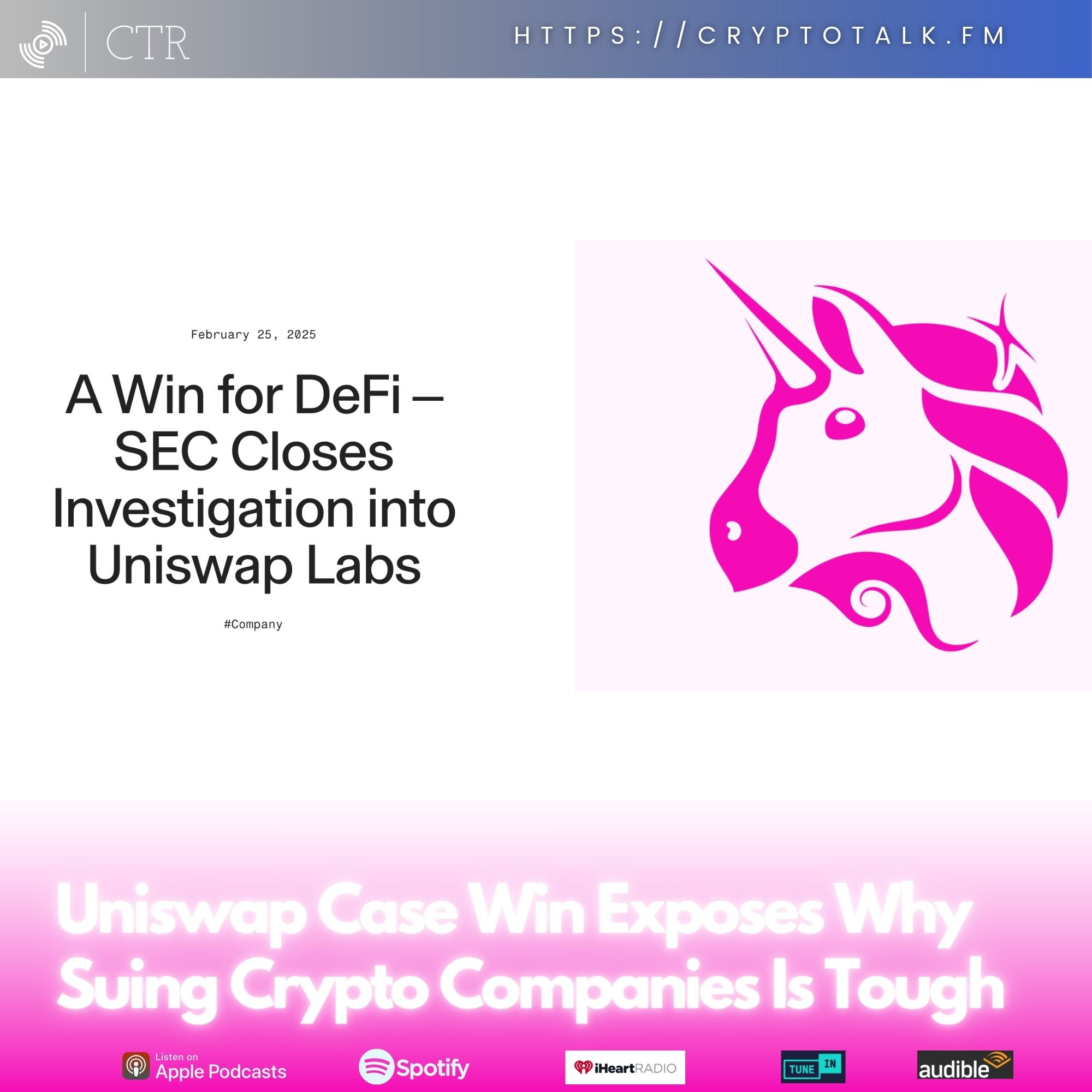
[00:08:26] The hard remainder of today's episode is going to focus on one specific court decision out of New York around Uniswap, one of the decentralized exchanges.
[00:08:38] Uniswap wins a court case essentially because what tends to happen is people get ripped off by garbage tokens and then they try to sue the distributor of said tokens. And the judge said, well, that's not going to work because you can't. They're just distributing it, they're making it available.
[00:08:57] But they're not the scammers. Your frustration is you can't find the scammers, the ones who really ripped you off, you know, like stranging you. You can't find the scammers. They're the ones who rip you off. You can't go off the platform that provided it to you. Now, the reason I like this case, and I do encourage you to read about this outcome, but the reason I like this case is because then legal experts broke down a number of different things that are usually attacked or they're vectors for attack, for legal action.
[00:09:32] And it breaks down kind of the response or the debunk or the rebuttal to said. And that I think is a learning lesson because I'm going to share at the end of this a scenario. It is a fabricated scenario, not born of any factual or actual name, person, place, color, creed, him or her, simply. So we have an example of these things because I think it's appropriate. So I'm going to go one by one, I'm going to share each one of these. Then I'm going to give you a real world example that is based on a fictitious situation so you can kind of wrap your head around what it's saying.
[00:10:09] The first one is generic swap, right? It's got. There's no specific Native swapping. It's just an open swap, right? You could just say token A and token B. It does. The swap comes to your wallet. There's nothing that is.
[00:10:23] No, there's nothing to this. It's just a generic whatever.
[00:10:27] Well, they're saying, the people who try to sue, they're saying, well, what? And this goes to my fictitious org. So let's assume you have some sort of a garbage token project or a garbage coin project or a garbage blockchain or a garbage dapp. Whatever. You know, it's garbage. Let's say you have a garbage something and you determine, or you think rather that. That there's some big money backer that's controlling the flow of money, right? They're controlling everything that's happening. Okay, since you believe that, you might not even have any damn evidence, but you believe that, right? Then what? It's. You're saying that this facilitates the scam. You are empowering the scam. And because you're doing that, we should be able to sue you.
[00:11:14] Because you're empowering the scam. You get what the connection is there. So they're saying, well, no, this, this. He should be sued too, because he's empowering the scam.
[00:11:25] Well, the courts basically can say, well, the. The easy defense for this is no, it's a tool.
[00:11:32] You know, you can't. You wouldn't sue. You can't sue gun manufacturers because somebody goes and shoots up a church, right? It's the same. It's a tool. It's just out there, might have lawful activity, might have unlawful activity. It's just a tool. You can't go after. They don't know. They have no idea. Because like with Uniswap, right? It's descent. They have. Now, I know some of this is bullshit because of Hex, right? But they're saying we don't have any idea of what people are using it for. It is what it is.
[00:11:59] Terms of service, you've seen on sites that they'll say, you know, we've got terms of service that say, you know, we're not respons. I've. I've talked about this. We're not responsible. This was terrarium. We're not responsible. We can't guarantee you liquidity. We can't do whatever. Da, da, da, da, da, da.
[00:12:15] People will try to sue over that. And they'll say, well, that warning is not sufficient. That warning's inadequate. That's a misleading warning.
[00:12:25] So let's use a fictitious example, right?
[00:12:28] Let's say you're fictitious company does some BS marketing and they tell you that, you know, we're going to get on 20 exchanges. I'm making up a number that we're going to get on 20 exchanges.
[00:12:39] But, but as part of the listing, we have to do xyz. We have to get this done. We got this done, this done, this done. And we have to make sure these things are all said and, and we need to make sure and we need to complete this.
[00:12:57] And by the way, it's possible you might get delayed. So they're doing all this information. This fictitious company, what this is saying is that people will try to sue that organization for false and misleading statements or false and misleading marketing because of what they deem false or fake terms of service disclosures and that kind of stuff.
[00:13:22] Now the problem with this as per defense, common defense is is, well, if they disclose, okay, so they tell you, hey, we're going to get on an exchange, okay, that beats deception. You can't claim that they're deceptive, which this fictitious company, sometimes people will sue and say they're being deceptive or misleading. If they're disclosing something, it defeats deception. So you can lose your case because unfortunately they were disclosing what's going on. Your counter to that would be, well, yeah, but they said A and it turned out to be B or they kept delaying it or kept rescheduling it. There's still disclosures. They're still telling you stuff. It's not like, you know, Saitama, where, okay, the failed November 13 Vegas event. He said, you will be able to use this swap on November 13th period. You get to the event, there's like, well, we don't have it.
[00:14:23] It's just straight up lie. That's different than we're going to have. We're going to have this thing happen. This is the date we're going to do it. Because of all the action going on. They say we got a delay, we got to reschedule. They're still disclosing the whole way. This is saying, well, there's a case to be made in defense because they are disclosing when they didn't really have to disclose.
[00:14:45] Then it's saying, well, wait a minute. If we take information and we do not. So this is basically saying, okay, well what if it's a live omission? You know, you'll hear that often. Well, they're, they're not telling everything. They're hiding certain things. So they're not really answering the question. They're not really saying Everything that they should. So it's a lie of omission. Is it really a lie of omission? I can't say. I'm saying the defense tends to be. Well, no, no, that's. What are you talking about? I told you what we knew at the time. And then they get beat in court or if information was not public. Now this is a big one. Let's take our fictitious company, right?
[00:15:27] The fictitious company, the, let's say the CEO randomly pairs up with somebody who's on the outside and starts feeding them information that's not public, it's not private, privy, they're not entitled to this information.
[00:15:41] Now if it's non public information that forms the basis of what's happening, that's a whistleblower kind of situation. The problem is is that if it's a non public conversation born of illegal activities for our fictitious company, it's not going to hold up scrutiny. Because what you're saying is you sat on illegal information and didn't go to law enforcement, which makes you somewhat complicit and that puts you at risk. And any competent attorney would tell you. So what you're saying is you were complicit and you stood by aiding and abetting, right? You stood by knowing illegal information, you sat on it for at least a month and didn't act on it. And it's fictitious company I'm talking about, that lawyer is not going to take the case. They're not going to go, it's not going to go anywhere because there's too much smoke because it was non public to begin with. The last one is, well, and you've heard this, if you, if something's told to you, right? So in our fictitious company, right, you got somebody and let's say he's standing on the moon and he's telling you we're going to do xyz and you chose to still give money. You didn't have to. You chose to. It's saying that there's an assumed risk because you were the things were disclosed to you and you chose to assume the risk.
[00:16:56] The argument this is saying is, well, yeah, but I didn't realize it was going to be delayed or I didn't realize that this was going to be a lie or I didn't realize this person was in charge or something. You say you didn't know, right? And that's the reason you feel misled.
[00:17:10] This is saying of course at the end of the day you assume the risk. Nobody forced you to do it. Nobody forced you to get away with that. And you can't go after platforms because this happened to you. You really need to go after this person over here. Now let's say for example, they just want to go after that person. Let's say there's one person they want to go after. The court case is saying that's assuming you can find them. That's assuming you can identify them. That's assuming you can prove that they are complicit or that they are guilty. That's the hard challenge. How can you do that? Because if you knew something, I talk about the non public, you knew something that proved that person's involvement and and didn't act on it at the time you were made privy to it. You have a hard case to make. Very compelling stuff that we've got on this list here.
[00:18:00] Then it's talking about promotions, right?
[00:18:03] Ads, regular listings and stuff.
[00:18:05] You know, any articles. We all know what that is. So what it's saying here or let's say for our fictitious company, let's say that the fictitious company says we are going to work with this rugby team, I don't know. And that rugby team is going to work with us as an advertising partner and a sponsor partner, etc so on.
[00:18:26] And for a period of time it appears this is true. And then later it all falls out. What this is saying is that, well wait a minute. This is. This makes it seem like they're helping you with the project and they're helping you fool people to get in and they're helping the scam because you're associated. So we're going after them too.
[00:18:44] The counter is saying well wait a minute. No, let's say that you are putting an ad up, which is very clear. Take the failed November 13th Vegas event for Saitama. They ran a Times Square ad. They literally ran an ad in Times Square, New York that said you will be able to swap this thing on site. A mask at the event. It was a lie, but it was a straight up ad. That's different than some sort of a listing in some directory or some sort of a listing on an exchange or some sort of a listing on the site of that rugby team. Let's say the defense is saying you can't go after somebody simply because they're listed somewhere and you can't go after whoever listed them for choosing to list them. You really don't have a case here because at the end of the day it might be that the listing. Org didn't know or didn't realize what was going on or Anything else. And there might be controls, like a contract that said this listing is, let's say, forthcoming or that it's tentative, that it's pending, or that's, you know, predicated off payment or something else that covers it. So you have this rugby team, this fictitious company. You got a rugby team. Let's say there's a contract and it says predicated off of payment being made, should the payment not be made, this contract's null and void. If there's a term like that, and let's say this fictitious company didn't pay the rugby team, then the contract just dies. Did that company lie to you? Technically, no. Because the contract they signed didn't guarantee payment. It simply said if you don't pay, this is going to fall out the counter from the suing people might be, but the advertisements do, the marketing dough, the everything going back to the other one. It says just because something's advertised.
[00:20:29] It all depends on compliance. It all depends on contracts, it all depends on legalities, if they covered their basis. In these arenas, you don't have a case because it comes back to personal risk. You assume the risk because you chose to do it based on something you didn't do due diligence on. So what it's getting at is you still jumped on it based on something you saw was true at the time, that was not verified when you did.
[00:20:56] Very fascinating stuff.
[00:20:58] Then it's talking about, and I love this one token, reviews, customer service issues on reviews, any sort of listings of things, Fees, right? So any sort of fees, any sort of charges, any sort of extra things going on. And a lot of these are talking about. You've got to look at the disclaimers and read behind the disclaimers, because chances are the disclaimers explain what's going on in the area. Customer service. For example, if they tell you, well, create a ticket, we'll respond to the ticket. If you create a ticket, they don't respond. It's still not a suing situation. It's something where you have a complaint, not something that rises to the level of a lawsuit. If you got something where there's fees, you have to look and see if there's a fee schedule. It might be buried in some documentation that's not broadcast. But if it's there and they can prove that it was there, you don't have a case.
[00:21:55] My point is this list of things where you just get beat in court and you get spanked in court is a fascinating list that I was glad to see surfaced. Although it was under the auspice, look it up of Uniswap. I thought there was lessons to be learned about what happens and how you win cases and how you lose cases. Because there's things that people don't realize about your cover your ass mentality. You know, some of these sketchy, shady actors who truly are sketchy and shady, they know how to cover their ass because they do just enough to stay above board in the eyes of the law. So you might have people with this fictitious company I refer to that they think they've got a case, they think they can sue and they think they can win because they've convinced themselves that they know more than than the person who's allegedly scamming them. All the while, it's possible that in this fictitious company, this person alleged to be scamming them is already 15 steps ahead of them, laughing at them as he turns his back. I can't say for sure. I'm saying that this is the world we live in when we have companies like Uniswap or others who put out a product, who make statements. I'll say PI Network as well. Sure, I'll throw them in there. I'll say Dogechain, I'll throw them in there.
[00:23:16] Solana at one point, I'll throw them in there. So many countless others who present something at one level, on the surface it appears as X and then call it a scam, legal action, follow suit, etc. All for naught. Because these people are very good at covering their ass, which is why they remain in the industry vis a vis Richard Hart. Folks, I hope this has been educational, helpful, informational for you to understand why it's very difficult in cryptocurrency to just leap to legal action. And it exposes a very fundamental flaw of cryptocurrency that will never be resolved. That being a lack of insurance. In the fiat side, you have insurance when it's in the bank. The bank can't straight rip you off. You will be made whole as long as you're not a millionaire, right?
[00:24:11] You will be made whole. You're a mortgage company. It's not really going to rip you off. Long as you pay the bill, you can stay in the house, right? There are certain fundamental understandings that are born from extensive regulations that don't yet exist on the cryptocurrency side.
[00:24:27] So at the end of the day, there's only one right, true, correct, logical answer. And that is do not put more money than you can afford to lose. Assuming this fictitious company were to exist. I would not expect somebody to be so damn stupid as to put hundreds of thousands of dollars of their mom's money into it. Again, it's a fictitious company, but I'm saying I would not expect people to put 40,000 or 50,000 or whatever number into a fictitious BS company that made lofty FS promises. And if they did make the lofty promises and somebody was dumb enough to use their mom's money in these fictitious companies, I would expect those people to slap themselves, slap yourself across the face and say, you know what? I jacked this up. I'm a dumb ass. Not them, that guy, that lady, whatever. Got me. He fooled me. She fooled me. Her tits got me fooled. I was too busy looking at Wendy O's chest and I wasn't paying attention. I was too busy watching this guy over here go to somebody else's house with a gun and his side piece in a truck. I was too entertained by these actors like an Andrew Tate. I was too focused on the person and not the fundamentals. And as a result, I chose to give money to. To somebody who might have ripped me off. I own that, not them.
[00:25:53] That's what I want you to take away from this. I want you to take away. The court system is starting to get smart about this game that's being played. It's a game. The game is these people are smart about how to duck the smoke. It's we're past 20, 21, where you just had kids spinning up garbage projects in. Even back then, those kids were able to get away with countless amounts of dollars because at the time, nobody was aware how bad it was going to get. We're way past that. Between Gemini and FTX and everything in between, you now have more awareness about how smart some of these people are. And my impassioned plea to you, my call of action to you is simple. Don't put more than you can afford to lose. Period, point blank.
[00:26:45] I understand some are gamblers that roll the dice and you can't help it. I'm going to continue making the statement that you stop gambling people's money. You damn sure shouldn't gamble your mom's money. But don't gamble your money either. When you see it's bullshit marketing. When you see there's no fundamentals. And by the way, don't come at me talking about it's misleading for this fictitious company, mind you. It's misleading because they present it like realistic. When you're talking about a fucking guy standing on the moon, you knew what you were doing. You are a gambler and you lost and the house won. Own that.
[00:27:24] That's it.
[00:27:25] Own it. Do better. Get smart. Grow up.
[00:27:29] Do better.
[00:27:30] It's easy. It's easy. Easy. Or.
[00:27:33] Or keep getting smoked when you try to do legal action for this fictitious company. Keep getting smoked when you try to do legal action. Keep getting slapped down by judges, getting slapped down by attorneys who are shaking their head while you're off in another room. They're shaking their head, laughing at your ass because they see this is just a gullible, dumb son of a bitch that got taken by somebody damn smarter than them.
[00:28:00] Meanwhile, Bitcoin's still there. Ethereum's still there. Avax is still there.
[00:28:07] Polygon's hanging on, but it's still there. You know, hbar is still there. There's all. Cardano. They're all. There's all sorts of ways that you can get into cryptocurrency that are smarter than investing in garbage. Fictitious companies, people. Just be smart, man. Why, why can't you just focus on the mainstream stuff in crypto? Why can't you focus on the stuff and everybody trades? I'll tell you why. Because you're still stuck in that bubble that thinks you're going to 10x off of a garbage token that's talking about a dog, talking about a moon, talking about an astronaut, talking about a cat, talking about peanuts and blockies and shit. That's what it is. You are too busy trying to make 10x off garbage. It's garbage. You know, it's garbage. Own the fact that you gambled on garbage. It's so bad.
[00:28:55] Da Vinci, Jeremy used to have a little segment of the show with Mr. M, whatever his name is, where they would just do garbage tokens. They stopped doing it because it wasn't worth doing it. Do you understand how bad you look when you are investing in garbage? And then you got the nerve for the fictitious company, you got the nerve to threaten legal action against these people and they just keep schooling you and spend thanking you and owning you and destroying you and laughing at you all the way to the bank.
[00:29:25] You don't get it. Okay, we're talking a fake scenario, right? But I'm saying be smart, man. Be smart. It's easy. It's easy. If you're going to be in crypto, focus on the ones that matter or do like Leister CryptoTalk FM.
[00:29:44] Make your money. All the jobs.
[00:29:47] Invest in other stuff that's going to make you money, like precious metals, that's going to make you have some wealth.
[00:29:55] Don't be like that numb nuts that banked millions of dollars off the bitcoin and then gambled it literally away after he got it. That's what's going to happen to you.
[00:30:08] Because you don't understand.
[00:30:10] You're trapped. Your mind's trapped. You're stuck in the matrix. You're plugged in. You. You don't understand. I'm trying to help folks.
[00:30:17] That's all I'm trying to do.
[00:30:19] You either take the help or don't. But when the dust clears, when it's all said and done, you've got one outcome. Your outcome is you lost.
[00:30:31] And you'll keep taking Ls until you understand why those people I say are so much smarter than you. You won't beat any of them because they're smarter than you. They've been at this much more, longer, faster, better than you. And you're going to keep getting embarrassed. You're going to keep getting let down by the fictitious company you're keeping let down and keep on happening over and over again.
[00:30:55] Or ignore me. It's great. I celebrate your right to ignore what I'm saying. I celebrate it because the passage of time keeps proving me right. That's why I love it. Time just keeps going. Time keep on slipping, slipping, slipping into the future.
[00:31:32] Sa.