[00:00:01] Welcome to Crypto Talk Radio, the podcast for everyday investors like you. Visit us on the
[email protected] and now here's your host, Leister.
[00:00:13] Thank you for that Bailey and welcome everybody out there in Crypto Talk radio
[email protected] Happy Tuesday those out listening here at CryptoTalk FM.
[00:00:23] Today's episode will be extremely short for two main reasons. One, there's not much to about talk talk about. Two, I need to get back to Fire Emblem Fortunes Weave because I need to get more progress done. But I am going to be talking about a couple of bits that are out there provide the regular coverage, news, you know the numbers. And then there was a post that I thought was really good that's worth talking about and I'll treat this as a 101 episode. I think that's a good We've not had a 101 in a while. It's long overdue. Let's go ahead and do that.
[00:00:55] Much more fun than talking about garbage type projects that happen to be out there spinning. I may have a brief mention, but I'm not going to spend significant time today. I think we'll save that for a different episode.
[00:01:11] Coinmarketcap.com we will zoom out to the month chart starting with bitcoin, which is currently hovering around the $86,000 mark, just above it with a strong upward trend.
[00:01:22] No signs of slowing down, although some people speculate it may be a what's referred to as a bull trap. The idea that there's artificial pumping where it's not going to sustain this is certainly plausible. There's nothing that tells me that this is fully legitimate, but the trend seems to be strong from my lens at least. I don't see that there's any weakness in the upward ic. I back that up with looking at Ethereum's month chart, which is currently hovering just shy of the $2,800 mark, significantly high even over the past week or so where it was down in like $2400 range. So between Ethereum's run up and Bitcoins run up where Ethereum looks like it's stronger than bitcoin, but they both look reasonably strong, I would suspect that we will have some more upward motion. I think I targeted $88,000 before we would come back down, settle back down and consolidate, that seems to be where things are moving. I don't know for 100% sure, but that's kind of my numeric target. That's just spitballing. There's no real science to mine. More gut. I don't do high technical. I leave that to others. They're better at it than I am. Mine is more gut. Based on what I see the charts seeming like it's doing and I'm settling on the $88,000 mark before coming back down. I could get it way off wrong, especially if it is a bull trap of sorts.
[00:02:38] Most of the news in the crypto space is quiet. The Clarity and its failure had a little bit of rumbling and it kind of came and went. It didn't seem to kill momentum, but it got people chatting about what the future will hold and what does this mean. ETFs seem to be still thriving in disregard to what happened with the Clarity act. Which is why I had said months ago at CryptoTalk FM that if you're going to get in crypto you should diversify. Get the regular assets too, if you want to, but don't ignore the ETFs, don't look, don't overlook opportunities to invest in other types of assets that frankly are much more reliable, stronger. They're likely to give you more confidence in your portfolio than with the hard cryptocurrency. Remember that the ETFs are already approved, they don't have to go through the hoops like the Clarity act do.
[00:03:27] And you can get it for your own establishment wherever you do your banking. If they have some sort of investment deal, some 401ks will do some things you can do IRAs. Most banking services offer IRAs. There's all sorts of ways that you can get into the ETF side and I do encourage you to take a look at those for disclosure. I do have the Fidelity Bitcoin etf and then I have an Ethereum ETF and I forget which one serves that one. It's on a different provider and I never look at it.
[00:03:54] But my hope, my hope was that the Bitcoin would go much lower. I bought in my ETFs when it was like 30, 30, 33 bucks per share and I wanted to stack more, but it's never been lower than like 50 bucks share. Like I'm significantly up and I never cash it out. It just kind of sits there and it's a, it's like a line of credit type deal. That's how I use it. I don't use, I don't liquidate it. I did liquidate some of the Ethereum ETF simply because I was trying to. I was considering rather shifting assets over, away from that establishment. But Then something happened with one of my other banks. I've got multiple banks. One of my other banks did something that really pissed me off and then they didn't respond when I called them out on it. So now I got to figure out how I move all my stuff over to one, if not both of my other banks that I have on deck. But I'm a big fan of having ATM access. The other banks are digital, they're fintech digital banks only. So I got to think about do I go with them and just call it a day?
[00:04:57] Do I deal with physical banks? Some of you might be like, well just go to Chase or Wells Fargo. Wells Fargo is a scam. Let's just put it that way. Google John Stump S T U M P H or excuse me, P F, sorry, Google that, jack off and see what he was doing to you and your money.
[00:05:14] Wells Fargo is a scam. I will never do business with them. Chase, which absorbed Washington Mutual way back in the day, Chase is, they're not a scam but they're, they're developers. Don't know what the F they're doing. So what happens? And I'm deviating a bit but I think it's relevant.
[00:05:32] What happens is I had an account ages out ago.
[00:05:36] This is when I was, I had a house out in Washington state and the house that I had there was a Chase like literally walking distance right at the road. So I opened up an account there figuring okay, the close banking.
[00:05:50] I had an issue financial issue at the time, it wasn't related, it was my fault.
[00:05:55] It wasn't like losing job. I just, I screwed up, had a financial issue. They didn't really help me out much at all. Like I, I think they're a terrible bank.
[00:06:05] I much preferred Citibank but Citibanks changed from what they used to be the Citi Gold used to be back in the older days you paid 25 bucks a month, you got a line of credit pre approved, you had infinite unlimited wires, yet unlimited money orders if you needed it. You could do cashier's checks, everything perfect. Then they changed it where they bumped up the amount of money that you had to spend, which is a joke and they got rid of some of the other services.
[00:06:34] So I was, Chase was like my only option left. Bank of America is a scam, I'll tell you that in a second. But back to Chase now. So I had the Chase account.
[00:06:42] I screwed up. It's what it is. I closed the account. So they didn't close it. I closed it Because I knew I need to get away from this and get a better bank. And I, I had the other one, the fintech still. But I wanted to have a local bank so I could get cash if I needed to.
[00:06:57] Later I tried to set up another account with Chase, their site, and I haven't checked since. But their site, it required you to enter your social. Fine, enter the social. And it's like, well, I see you have an account here already. Enter your password. I'm like, I don't know what the effing password is. This is like 2023 or something. And when I had the account that had been 2014, so I had no idea what the password was. I hadn't used them in almost 10 years or over 10 years. So I'm like, I don't know what the password is. They do a reset, right?
[00:07:27] To do the reset, you enter some information. They want something of the account. So it's like the last word, the account number or last for the debit card or something. Some garbage. I don't have any of this stuff. The all of the banking information that would answer the question was lost in the financial situation. That was my fault. It was all lost. They were in boxes that were, that were lost.
[00:07:49] And I think some of the other, like I kept some statements, paper statements that was shredded for security reasons because 10 years. So I didn't have anything to be able to give this account. It's like, dude, that was ages ago. I have no idea what it is. I, of course I got rid of the card. I wasn't using you guys. And I'm calling them, they escalated it all the way to the executive office. Nobody could help, nobody could figure it out. They apparently it was hard coded. Just if you had an account, you basically have an account for life, which is bad security practice, by the way. What they should do is the account gets discarded after a period of inactivity. It just, it gets deleted. So you can create another account. They don't do that. They said, well, come into the branch and do it. I don't do that because although it's easier to do, I'm. I work from home, so I don't have bankers hours aren't available to me. They just aren't weekend I could do. There's not a Chase local, even if there was one local again, it's a terrible bank for what they're doing online because I can't log into the online anyway.
[00:08:46] So it, so I said, okay, no, no Chase, we're not doing that. Wells Fargo Is a scam. So now bank of America, right?
[00:08:52] Years ago, when I was, When I say years ago, I'm talking, I was a kid this long, long time ago.
[00:09:01] I had, it was the first bank. I had an account when I turned 18, and I think I was even before 18. I got my first account.
[00:09:09] Nobody taught me because just what it was. Nobody taught me checking account's not free money.
[00:09:15] So I wasn't ever taught what not to do. It's just, okay, it's whatever. And I'm writing checks that I'm shouldn't be, right? So, so fine. It is what it is I get. When I started working, I got direct deposit set up because I was sold at the time. It wasn't a default at the time, it was just. It's available if you want it, but it's not required. You can still get a paper check Back then. Back then they were not forcing direct deposit like they do now.
[00:09:43] So I did it because, okay, cool, I'll let it direct deposit. I don't have to wait for the paper check. I don't have to go down to the bank. I thought it was a cool thing. Some kid, right? Teenager.
[00:09:53] Fine. I do a direct deposit one of the days and I still don't know whose fault it was. I have a theory, it was my company, but the deposit was doubled, it was doubled up.
[00:10:04] So I would, my routine was I would go to the ATM after like 10pm because usually it's a three hour wait. So on payday it waits till the Friday. So Thursday evening I would go at 10pm Just after 10, I would go to an ATM and see the money's there, so I could pull it out. Because I was a cash person back then. I wasn't swiping. Nobody was swiping the debit card back then. We were all cash. I'm still cash, but I would go to ATM and I'm looking, I'm like, okay, wow, there's more money in there. I didn't think about why there was more money. I'm just like, okay, it's money, it's a routine. So I pulled it all out.
[00:10:38] I get a nasty gram in the mail. Pretty sure it was the mail. And it was saying there's some sort of error and this was doubled up and you need to return the money. I'm like, what do you mean return? This is put in my account, it's mine.
[00:10:51] And I think I called them or something. I might have gone down there. I might have gone down there and they're like, yeah, you need to return it. That was an error. You're not entitled to that money. You should not have gotten that. Like, it was in my account. I pulled out what was in my account. I didn't do anything wrong. And it went back and forth and back and forth and back and forth. And I think.
[00:11:11] I think they even closed the account. I think they basically were just like, okay, I'm just gonna close the account or something. If I recall, then a couple years later, I get another nasty gram where they're gonna try to take me to collections. We're talking 500 bucks. We're not talking a major amount of money. Obviously, I'm a kid, so 500 bucks was important for me.
[00:11:32] And again, I had long since spent it, and it's in my account. I didn't think anything of it. I let them take me to collections. I was like, screw it. And it stayed on the. Obviously to the credit for seven years. And credit's a scam. So bank of America is a scam, okay? Bank of America is a scam. Wells Fargo is a scam. Chase is a joke. They don't have their developers all situated.
[00:11:53] That leaves basically regional banks because there's not a lot of large ones. You know, you got like pnc. PNC is not all over the nation.
[00:11:59] PNC is Midwest and East Coast.
[00:12:01] You've got associated, associated Midwest and mostly Midwest. You've got old National. They're mostly East Coast. Like, you've got banks. And there was one. I forget what the one was. There was one in Washington State. You've got those banks that are larger, but they're regional large. They're not like all over the place large, like Chase, bank of America, Wells Fargo, U.S. bank, kind of sorta U.S. bank. I don't want to call them a scam because that's not fair. But they feel like they don't know what they're doing, which is sad because I used to really like them. When I was a kid, I would take my check, paper check down there to have them cash it at the counter to get the money. I wasn't doing direct deposit because, again, it wasn't required. And I was a cash person. It was faster just giving the cash.
[00:12:49] And there was a point where I didn't have a bank account. You're thinking, how is that possible? You got to understand that back then it was actually hard to get bank accounts. You would get denied for bank accounts. I actually went to a different. It was a credit union.
[00:13:03] This is ages ago.
[00:13:06] They wouldn't give Me a Visa debit Card or a MasterCard debit card. It was just a blank generic ATM card. So all I could do is get money out of the atm.
[00:13:16] Because at that time they were really rigid about the approval, approval criteria for an account. Even if you walked in the branch, they were really rigid. California Coast Credit Union jack offs, same thing. I walk in there, try to apply and I got denied walking in there. It's a different era now. Now you can pretty much walk into a bank and they don't really care as long as they can verify your identity. They're just whatever because they know they're going to get money out of you one way or the other. But at that time it was a lot harder to get accounts. So I would take the paper check and I would get it cashed.
[00:13:49] US bank, that's the whole thing. That was all they were really good for. Union bank. They were a great bank. Then they started closing branches. All of which to say that the banking, the whole banking industry just got shuffled over years to the point that it's too centralized. And that's what caused the rise of fintechs. And that's why I have fintechs that I use, that I rely on because I don't have a choice. It's not what I want to. I don't have a choice to because there's no nationwide bank and I, I don't necessarily need Nationwide now. But when I was traveling it was important. Whatever the bank, it's like, well, you could use somebody else's atm. Sometimes they charge fees. Sometimes it's like I paid crap, tons of fees when I was traveling, driving the roads with the little small ATMs and the gas stations. It's a joke. All point, yes, sure. But then you have limits. Okay, you can only pull 500 bucks. It just isn't work worth it. The best way is just to be able to go to the branch, walk up to the counter and say I need 5,000 bucks out. Right?
[00:14:46] That's, that's what it should be. And it just wasn't that way. And fintech doesn't do that for me. So I've lost it.
[00:14:53] But with the rise of fintechs, they have focused very heavily on the ETFs and making other things available besides banking because they got to make some money. So that's why I told the roundabout story of my journey of why I have fintechs that I'm using for the ETFs that are tied to crypto now.
[00:15:11] Because I wouldn't have had the opportunity to do that with the jack off banks that I was dealing with physically to the point that I largely abandoned them. And people will say credit unions, but it's the same problem.
[00:15:22] Yeah, sure. Mission Federal, Navy Federal.
[00:15:25] Mission Federal is essentially near dead. Navy Federal, although it says they're open to everybody. They're not really.
[00:15:33] I do come from a military family. They require proof I don't have because I don't have my military id. I have no idea what happened to it.
[00:15:40] I literally have no idea what happened to it.
[00:15:42] Never got renewed. Never got another one. Like, I'm not. I'm not going through something where I got to jump through hoops to prove what I say. Okay, that shouldn't matter. It should be okay. We'll verify what yours is. Bring a birth certificate. It has one, actually two military people listed on that one. You go to the military records. Okay, that's the same person. We're going to auto approve you. No, it's not. Well, you got to go through this and you got to list their contact or we got to call them. What for?
[00:16:10] What if they're dead? What are you supposed to do then? Well, we're. No, I'm not desperate. No, we're not. It's stupid. It's dumb because they're not trying to give you those accounts. This is what contributes to the rise of fintechs trying to take over the banking industry because they understand it's all a joke with some of these local banks and some of these local branches.
[00:16:30] So I did that shift and then the ETFs came along with. And then as part of that, I just put money in them and kind of let them sit and watch them grow. And, you know, they're more stable than I would ever have had with the physical banks, which is why I'm encouraging you to consider the ETFs, especially if you have a fintech. I'm not telling you to get into fintech. It may not be for you. I am telling you to make sure you continue to consider the ETFs as part of a diverse portfolio.
[00:16:58] Because I believe, and I've always believed, that the ETFs are a door.
[00:17:03] Not for you to get made a millionaire overnight. That's not the goal. It's to have stability in your portfolio so that you're insulated from disruptions that happen, whether it be banks shutdowns, whether it be wars, whether it be the president, whether it be whatever, somebody's whims.
[00:17:20] I think they provide a strong basis insulated from a lot of the garbage that's going on in in the recent eras.
[00:17:28] The last part of our episode will be our brief quick one to one and the one to one is simply to talk about something that was interesting. Again, I'm not going to focus heavily on the project. It's not important. I'm going to simply talk about what I saw here and it is relevant to that project. But I'm not going to dwell on the project.
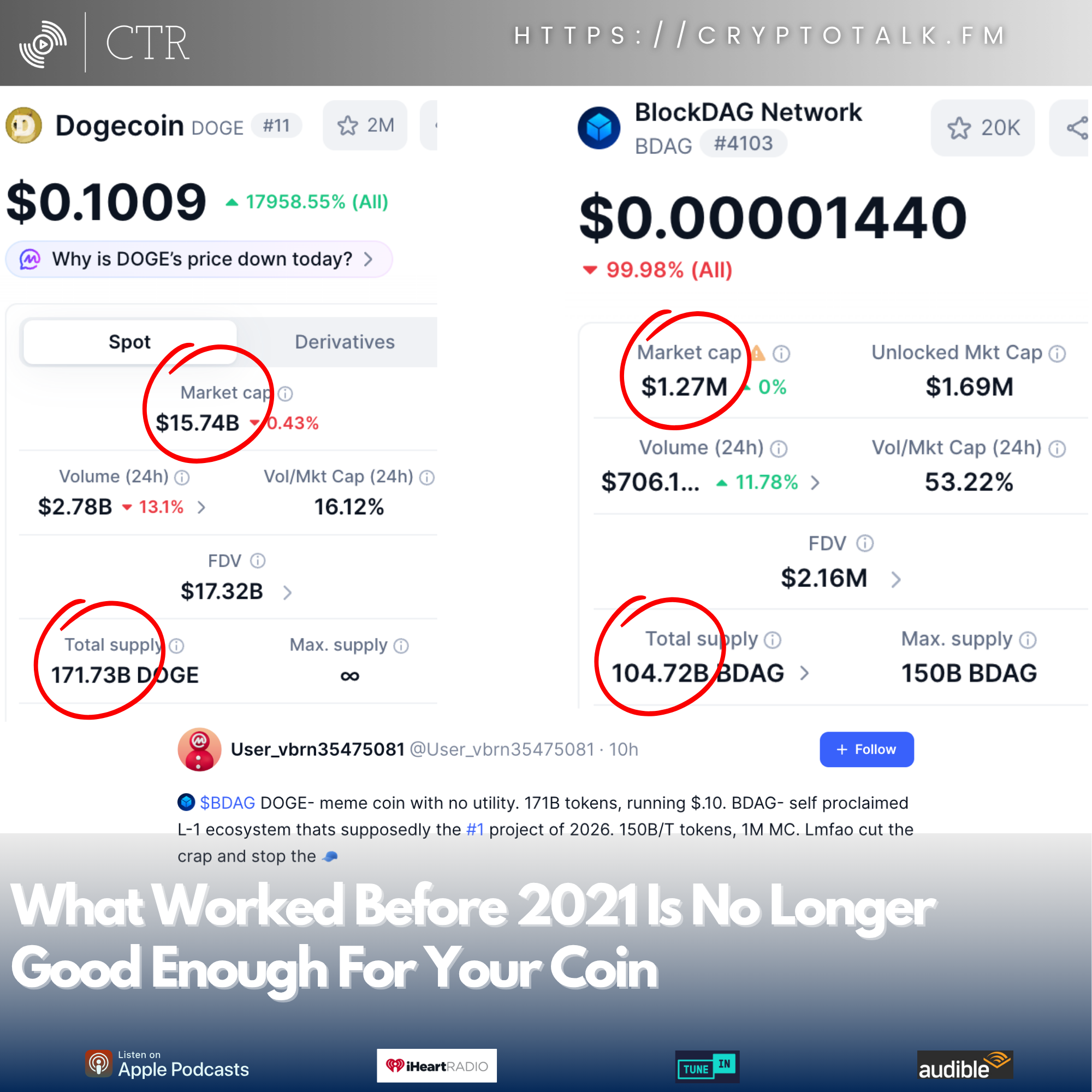
[00:17:51] The user is one of the random names, so I'm not going to spell it out, but the user put a post up on coinmarketcap which says quote doge meme coin with no utility 171 billion tokens running at $0.10 BDAG which is the block dag garbage self proclaimed level one ecosystem that's supposedly the number one project of 2026. 150 billion tokens 1 million market cap LMFAO cut the crap and stopped the cap pause.
[00:18:23] So by the way, the term cap is a gen alpha term which means stop lying. I don't know why they say stop lying. In any event, they made a very important point here.
[00:18:35] Doge which truly does have close to 200 billion and their coins, not tokens in their circulating supply. You may not know that Doge Prince and I think it's 10,000.
[00:18:49] There's some number that it prints every single day because what it's trying to do is provide a form of measured managed inflation over time, so its supply constantly increases. But the point being made is that despite having arguably more and worse on the supply side, Doge is able to get to $0.10 per where block dang has four zeros in front of it. At one point it got as as low as five zeros in front of it, but it has four zeros in front of it and that it's not able to get to anywhere near the price movement of a doge.
[00:19:23] The 101 I want to share, although this is factually accurate, you need to understand the reason and timing is very critical on this. But the reason why Doge was able to do what it did Doge at the time and even now doesn't do anything.
[00:19:42] Doge was created. Its whole point was to provide an alternative to what was happening in the industry overall with the bitcoin piece and basically say we're just going to be a standard coin, we're not going to try to be on payments, we're not going to try to have utility, we're not going to try to do anything. But we think we have the better product. We think we have something that's worth more your time because it's not trying to be overseen like the rest of them. Especially when you looked at Ethereum, when Ethereum moved from proof of work to proof of stake and its price plummeted accordingly. And you have bitcoin that's suffering ever so slightly. It runs up, but it comes back down. It runs up and it comes back down. It suffers under manipulation at certain levels, price manipulation at certain levels.
[00:20:34] Some of that manipulation is because bitcoin is used as a store of value by some. It's also used for liquidity by a lot of the exchanges. So it's paired within the exchanges to all these other various projects. It is used, its value is used. This contributes why you see a lot of the price movement running lockstep with the price movements of bitcoin, including Doge.
[00:20:59] Doge's message was always as a standalone coin. We're just here. We don't do NFTs, we don't do anything. We're just here for essentially for trading purposes. And it's meme focused. It all started with the Dog meme. It's meme focused and that's all it wanted to do at the time that Doge became peak popular, which is prior to 2021.
[00:21:23] Consider that at that time there was a strong focus on cryptocurrency not having utility and instead used within the cult. When I say the cult, I'm referring to those people who saw cryptocurrency as simply their own little pet project, not something that was going to be making them a millionaire. But it so happened. And Doge took eight years to get to this point. It so happened that the popularity and the viral marketing of it, not by the team, but by the people inside of it and word of mouth and social media and all these other perfect storm factors contributed to where it got.
[00:22:02] Same is true of Shib.
[00:22:04] Same is true of Floki, which is a three time rug pull by the way. Same is true of every other project that was able to do those. Pepe, another great example where it doesn't really effectively do anything, but it had the benefit of the right time and the right place that caused it to run up. Now the lesson to be Learned in the 101 of this listener consider that you got a project over here that essentially does nothing, is proud to say it does nothing, is proud to be a meme, is proud not to try to do anything more than nothing, and it's able to capture so much Attention from people.
[00:22:42] But the timing matters. That that time, that was people's priority because it was new. It was still in its new infantile stages. There was no strong presence across the exchanges. There was no strong presence across the news. It didn't essentially have an audience other than internal cult audience. That's all it had later. Now nobody's talking really about Doge. It's just kind of out there. They're proud of that, but nobody's talking about it. Nobody is focusing on it. Everything is focused on Ethereum and Bitcoin to a lesser degree, the Robin Hood garbage chain to a somewhat degree. Solana. Solana had attention at a point. It's died down.
[00:23:25] All roads lead back to Bitcoin. And to a lesser degree, Ethereum has always been the case, will always be the case. The ones, the second ones, the Phantom which changed, the polygon was changed. All of these had attention at a point and then they lost the attention.
[00:23:41] It's cyclical because it all comes back to Ethereum and Bitcoin.
[00:23:45] With what's happening with this comparison as perfectly done, it tells you how block DAG is a project, how easy it would have been for it to have been life changing if they hadn't done what they tried to do.
[00:24:04] If they had tried to simply be a bit basic something and they had done it at the right time.
[00:24:11] Consider how much more it would have been. Consider how much more popular it would have been up front.
[00:24:17] They laid out to do all sorts of lofty stuff.
[00:24:21] UTXO models and proof of work over top of EVM and DAG layer structures and academies and all sorts of stuff. Lofty things. Consider all of those things cost money.
[00:24:36] This is not in dispute. Hear me.
[00:24:39] All of those things cost money. Somebody's got to pay for it.
[00:24:43] If you consider that the pre sale was designed to help pay for those things, it meant you were buying into those things, not into the project.
[00:24:53] You might have expected a return later.
[00:24:56] But what's that based on? A guy kicking on the moon because it didn't have anything.
[00:25:01] A guy kicking on the moon, ironically, would have worked really well as a meme. And when I say kicking on the moon, some might not know what I'm talking about. There was a video. This is early stage, I want to say early 2025.
[00:25:13] There was a video from the guy that's on the site. Not the broccoli hair dude, but the other dude.
[00:25:18] There was a video and he was talking about something about what they're going to do. People in the Telescam Allegedly were criticizing the fact that this is AI.
[00:25:28] So then they released another video with the guy. And by the way, all the keynotes are deleted from the site, so you can't see this. But they released another video with the guy. He's talking a little bit and they just kicks his leg out. Because the criticism was we think it's AI. He's not even kicking his legs, not even moving. He's just standing in the same place. He's not moving. So they had him kick his leg out as part of the AI to disprove the narrative that it was AI.
[00:25:50] Obviously it's AI. We knew it was AI. It's always been AI.
[00:25:55] But consider that this, that's perfect meme material. When if you saw that and you look at what's happened and you look at how disastrous it's been, it's all meme material, this could have skyrocketed. It's like we're going to create just a basic something.
[00:26:13] We're going to put it out there for sale behind a heavy hype marketing machine. Everything that happens, regardless, everything that happened hype marketing machine. We're going to put it there and put it on all as many exchanges as we can after the cycle completes. So it goes on exchanges, it has the marketing hype, it launches, it does what it does, then you start building things.
[00:26:39] Now, this is contrary to what you ideally would want to see. Ideally you would want to see the products before you go live on the free market. I'm not disagreeing the difference here.
[00:26:51] If you do it the other way with the products before the marketing and before the launches, that assumes that those products are paid for not by you and not by your pre sale.
[00:27:01] So if we're going to say that these products that were designed were always intended to be paid for using the pre sale money, you're gambling, you're rolling the dice that a they're able to pull it off be they're not incompetent. See the regs let like there's all these layers of risk sitting over top of it. Instead of. In this case, what might have made better sense is to simply have a basic coin. It's just a coin. It's just a like Doge chain. It's just a coin. Like Robin Hood garbage. It's just a coin. We're going to put it out there as a chain and then build within that and build over top of that.
[00:27:40] Think about what that might have done. When you talk price comparison using Doge as the model, Doge able to get to as high as 10 cents when it acknowledged it didn't do anything. And to this day doesn't do anything. It didn't need to try to do anything. It didn't lose its value because even now it doesn't do anything and yet it sustains its value.
[00:28:04] It's. It's an interesting dynamic to have something that doesn't do anything.
[00:28:09] Not only generating strong value and momentum doing nothing, but also sustaining its value over a significant period of years where this other project that focused hot and heavy on all these things it wanted to do, couldn't sustain, simply backs up what I was saying.
[00:28:28] I think they went too lofty. I think they tried to do too much.
[00:28:32] They didn't have any sort of strong competence in there to pull it off that way. They banked on pre sale money to pay for all that stuff.
[00:28:41] They went over budget because they were trying to do too much. There's actually an old AMA floating out there from Turner where he's talking about the Borussia Dortmund in Inter Milan. This is before they stiffed him. And it seems like Turner was the one who negotiated getting on those. So. So he's the one that set it up, but he had not coordinated the payment when he did that. So he got the arrangement somehow, possibly through, you know, some sort of old relationships or something. He got the setup, went to the well to get some money and got. Got his hand slapped. Didn't get the money. Not getting. Not them not getting paid.
[00:29:18] Which was why people had questions, well, why then did you do those partnerships if you didn't have the money? Because the left hand wasn't talking to the right hand. The left hand, which is Turner, had all these lofty visions about what was going to happen and then contributed to some of that marketing business and some of the blitzes. Because his alignment with that, he's pictured. He was out there on the field, he sold up a shirt.
[00:29:40] His alignment with that, he me. That means he was lockstep with the marketing of it, right? Well, he's lockstep with the marketing that he himself on his recent videos admits was a chaotic nightmare, was over lofty and whatnot. And yet he stayed.
[00:29:55] We have to put that in perspective because with all the things that we know they did, we know they partnered with Alex Pereira at a point. We know they partnered with Borussia Dortmund at a point. We know they partnered with Inter Milan at a point. We know they partnered with F1 at a point. We know they went to Tokyo 2049. We know they did these things. We know they did the hackathons. We know they did these things. We know they had an academy. We know they did these things. We know there's a chain. We know they did these things.
[00:30:22] All I'm saying is all of that costs money.
[00:30:25] All of it costs money in some way.
[00:30:28] It's possible.
[00:30:29] It's entirely possible.
[00:30:32] If they had not gone too lofty and not done too much, it just simply put out a basic chain, the value of this might have been way higher.
[00:30:40] And that's the interesting thing of crypto.
[00:30:43] Sometimes too much is just as bad as doing nothing at all. Now all you can really do is sit back and watch as idiots and liars on three sides do whatever they're doing.
[00:30:55] Meanwhile, you're sitting, waiting on your money. I don't know what to tell you. I can't tell you anything because I don't know anything. All I do know, which is obvious because you see it. There's liars on all three sides. You simply have to choose which liar you believe more. Sam.
[00:31:34] Sa.