[00:00:01] Welcome to Crypto Talk Radio, the podcast for everyday investors like you. Visit us on the
[email protected] and now here's your host, Leister.
[00:00:13] Thank you for that, Bailey. And welcome everybody out there in Crypto Talk radio
[email protected] Breaches and Cracks and hacks oh my.
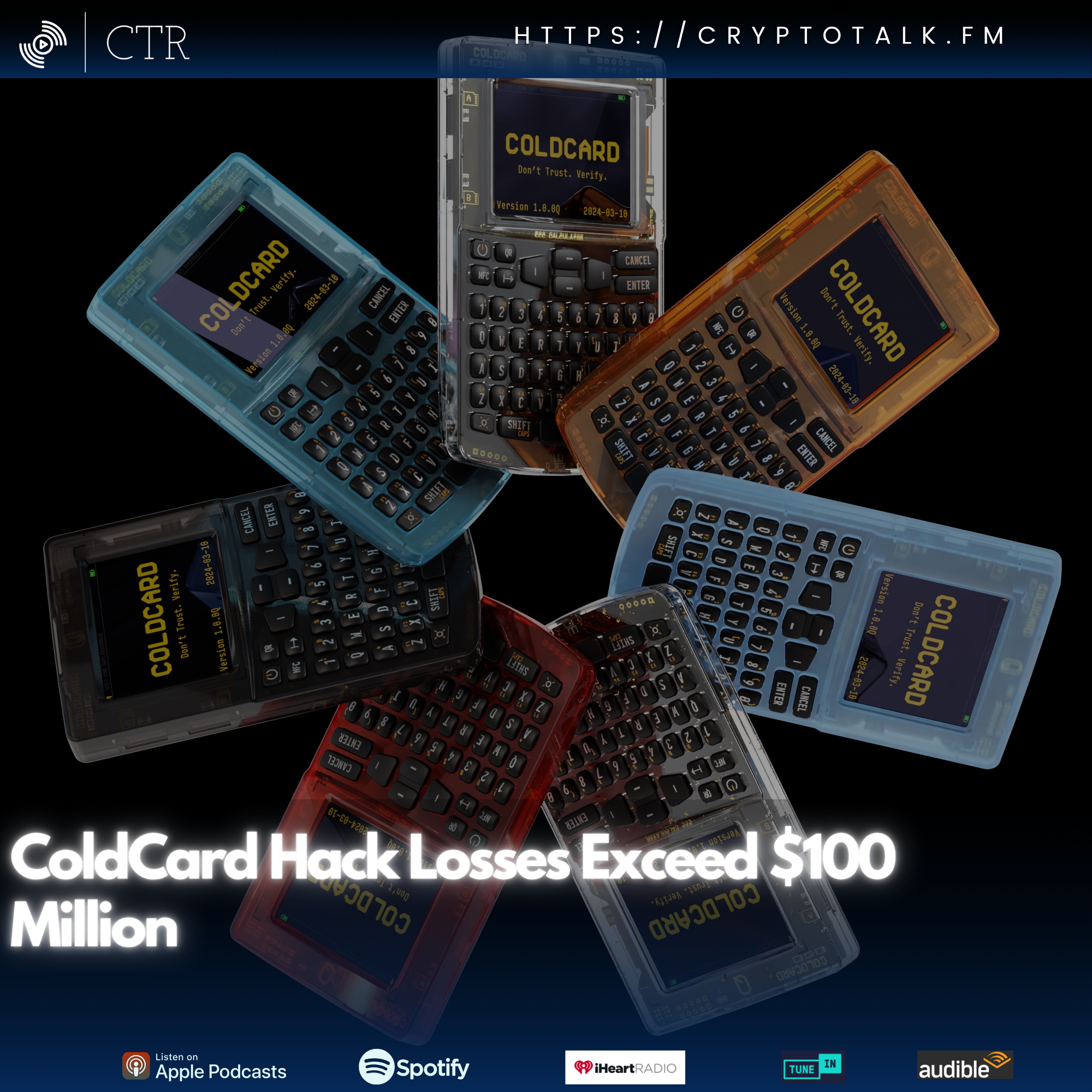
[00:00:23] The cold card hack has people freaked out and pissed off. I would surmise if you are a person who listens to DaVinci Jeremy, who a while ago said it's basically impossible for your bitcoin phrase to be or your he said private key. But you know what I'm saying that your bitcoin is hard to breach it the quantum, it's highly improbable. Hopefully my explanation, which will be in layman's terms best I can, will help defray what he was saying. I get why he said it, but I don't think he fully understood. And I, I theorize the timing of this hack a little bit too convenient with the whole clarity act. I'm going to go into that a little bit deeper. Let's jump right into this. This probably won't be a long episode.
[00:01:14] Coinmarketcap.com we will zoom out to the month chart starting with Bitcoin, which shows somewhat of an upward trend, currently hovering around the $64,000 mark.
[00:01:24] As I record this, Ethereum also shows a little bit of an upward trend on its graph, currently hovering just shy of $1900. I think Ethereum's trend is a little bit stronger than bitcoin. From my lens I say that and of course it's down about a hundred dollars. But it does seem like it wants to go up. It just isn't currently equipped to likely because of everything that's going on with bitcoin. I think that's, I think it's contributing at least somewhat to price movement across the board, which I'll be talking about here shortly.
[00:01:54] Quick and dirty let's talk about the cold card chaos then. I have something about decentralization because it's somewhat related the cold card chaos. If you don't know what it is.
[00:02:07] Let's start with cold card.
[00:02:10] Before we can talk about cold card, we need to talk about cold wallets and cold storage. Cold wallet the concept behind a cold wallet, there's two parts and some people were not aware of one of these two parts and I want to help where I can, but I'm trying to explain it in a layman form so that anybody can really absorb what it's talking about.
[00:02:35] The first part is that in theory, the cold wallet is not affected by connectivity to the Internet.
[00:02:43] And by virtue of this, it is expected to be nearly impossible to reach it in order to breach it.
[00:02:51] The second part, the one people don't talk about, is that cold wallets generate their secret phrase differently than other wallets.
[00:03:01] I don't want to bore you with the technical details. Suffice to say that there are two different ways to generate these phrases.
[00:03:09] One of them is done the standard quote wall way. When you generate a wallet through a web interface, or you generate a wallet on your local computer, or you generate a wallet on your phone or some other device that has an operating system. The key here is you have an operating system. The operating system is running on a device that has a certain type of processing that's happening, and the operating system itself can provide the necessary information to generate the random sequence of information necessary to give you a secret phrase.
[00:03:45] That's the simple form of it.
[00:03:47] A cold wallet works a little bit differently. The cold wallet has its own technical way of generating that phrase.
[00:03:56] It is a form of operating system, but it is very stripped down. It only has a singular function to it. It does not have the diversity of function. As a result, they've created a very specific way of generating that phrase that's inherent to the hardware. The cold card hack, there's multiple parts, but the biggest standout to me as a former auditor is the fact that firmware that they deployed ultimately did not strengthen the way that it was generating the keys. The sales pitch of cold card was simple.
[00:04:32] By doing it this way, you are the ultimate self custody. It is literally impossible for somebody to get access to your stuff. Da Vinci Jeremy talked about this, that it is nigh impossible that quantum computing was going to be able to breach your deal.
[00:04:47] Now the hack has debunked what Da Vinci Jeremy said, because although quantum computing was not used, the fact that it was even to be able to be breached is a slap in the face to anybody who believed that narrative that your wallet could not be breached.
[00:05:04] Because it turns out the hackers simply used a brute force strategy. Brute force strategy. Put simply, they were able to replicate the generation logic for the secret phrase.
[00:05:19] They took the exact same code, they ran it through an engine at high pace, and it was basically generating these secret keys until it got a hit.
[00:05:30] That's literally what happened. They ran through all the different iterations it could find until it stumbled across hits. That's still going as of right now. Last count was up to over $110 million breached thousands of Bitcoin wallets because. And the strength of the key is not something you control in the cold card. You can't tell it, I want a stronger key. You can't tell it, I want a secure key.
[00:05:55] The key you get. The key you get, the key you get.
[00:05:58] So there was nothing you could do to protect yourself further from what happened? It was going to happen.
[00:06:04] It just so happened with this firmware that they did not do due diligence in making sure that it was properly secured the best they could.
[00:06:13] But ironically, some of what was discovered is that the very nature of wallet keys in general is at risk to some degree and increasingly. So this is where I get a little bit more technical, but I'll try to keep it a little bit low key.
[00:06:31] Your secret phrase for most of you is 12 words, and they're gibberish words. They're not a readable sentence, but they are normal words. But there's usually 12 of them.
[00:06:43] The 12 is the minimum standard, similar to passwords that used to be seven characters minimum.
[00:06:50] We had to increase the standard because it was getting easier to breach the password. That's what's happening with the wallet secret phrase. Because they are so low in the count of words in the phrase, it is starting to be easy to eventually guess it. Now, how probable is it? Are we talking something in a matter of minutes? No.
[00:07:12] But as computing gets stronger, as people get more creative, as the methodology gets a little bit more predictable, we're starting to see patterns of these kinds of breaches where you wouldn't even know it because they didn't even touch your direct wallet per se. They simply were able to guess your secret phrase, set it up on their wallet, and drain you blind.
[00:07:37] So if you can't keep it on an exchange because you're told not your keys, not your crypto, and you can't keep it in a self corporate custody wallet because it could get breached due to no fault of your own.
[00:07:48] Well, what are you supposed to do?
[00:07:51] Well, there's a couple of things that are recommended. Some of them are in your control, some of them are not.
[00:07:56] The first thing that's in your control, directly in your control, try to find a wallet that offers you a 24 word secret phrase. This is not going to eliminate the problem.
[00:08:10] It simply makes it a little bit more complex and buys some more time until cryptocurrency wallets get a smarter standard. Again, I'm not trying to instill fear in you. I'm saying that cryptocurrency has to grow up with respect to how we secure the wallets.
[00:08:26] And I don't agree with the idea of some wallets going to like Google sign in or some of that other crap. I don't agree that you should have to have any Internet access whatsoever because that flies in the face of self custody. Let's say Google if you know, killedbygoogle.com, if you do Google sign in and they decide to kill that one day, you're screwed. It's not the right answer. You should not have to depend on a third party service to get into your stuff. We simply need a smarter front door. I don't have an answer as to what that is. I'm saying that we need a smarter front door that does not depend on any Internet service that we don't control.
[00:09:05] What I'd like to see, and I don't think I will, but what I'd like to see is a vault concept that you can set up in the privacy of your own home.
[00:09:16] Somehow I don't know what that means, but somehow where it's a double factor, but it's physical.
[00:09:24] So picture as dig, if you will the picture, right? Picture this.
[00:09:30] You have a device. It could be a tablet, could be a phone, it doesn't really matter. Computer doesn't really matter.
[00:09:35] Whatever device supports Bluetooth. Bluetooth is a ubiquitous standard. It's not going anywhere anytime. In the short term you have some sort of ring.
[00:09:45] Could be a watch, but I think a ring would be good. Maybe a necklace, some sort of something that is simply its sole purpose in life is to provide the other half of an authentication. Physical authentication doesn't need more than a single button on it. It doesn't need a screen, it doesn't need anything. It just needs a single button that you can use to sync it the first time. And your device of question seeks that out, meaning you have to hit that button in order to get it to unlock something that simple. I think that would be the cleanest way of dealing with it because it would be near impossible to deal with that. It's like a pass key without the physical, you know, without the biometric aspect to it.
[00:10:28] I would love to see something like that. Something that does not something that is. You'd have to basically take somebody's, you know, a cost, look it up, somebody physically in order to get access to a device. Something like that. That's what I'd like to see. Who knows, maybe I might invent something like that. That's what I like to see the other thing to think about. So first try to find a wallet that supports 24 words in the secret phrase. It's not easy. I can't think of any on top of my head. I will go and do some searches. I'm just going to do my Prism wallet to do that because I control that code. But I will do some searches, see if there's ones I can think of but I couldn't think of on top of my head. I know they're there. I just, I have not dug deep into it because it wasn't a priority for me because I don't store significant crypto in any one wallet.
[00:11:17] But I will do the digging in case you people are curious out there. So that's the first thing. Second thing, I don't like PIN on the wallet. I think it's stupid myself.
[00:11:29] I like perimeter security. Can't get in the device, you can't get to the wallet. However, having some sort of pin or biometrics or something helps with the encryption.
[00:11:40] It still does not mitigate what we're talking about because that encryption is only for your device, not for the wallet and not for the blockchain. So it does not save you. But it doesn't hurt either that way if your device gets stolen or something. Right? The the root of the problem is that phrase and the phrase has nothing to do fundamentally nothing to do with your device. Another option that I would love to see wallet providers consider is to combine that phrasing somehow the generation of it with attributes that come from the device where the wallet's created.
[00:12:21] Now that the trick of this is it means that I could reuse it certainly fine. The only way I could regenerate it would be to have the exact same device where the wallet was created.
[00:12:34] That's not really a bad thing. But how many different variations of a device might somebody store where it's possible some sort of brace still happens? That's why I like the physical device option.
[00:12:47] And I'm just spitballing. I am. I'm a fan of physical. I'm a fan of not having to rely on Internet and I'm a fan of the 24. Sure. And I'm a fan of this physical that I was describing things that do not rely on a third party service, that do not rely on Internet, that don't rely on services that could die. That's where I'm at with it.
[00:13:07] For the remainder of the episode we are going to chat about decentralization, which is getting thrown around again, especially in the context of banking and the context of the Clarity act, which is in trouble, and the context of certain projects that are out there.
[00:13:22] First, we need to define decentralization, because I struggle, I think people don't know what it really is. They think they do, but they don't.
[00:13:32] What is decentralization really?
[00:13:35] Decentralization is the idea that there is no singular authority with respect to, in this case, cryptocurrency, but it doesn't matter. But there is no singular authority with respect to decisions, with respect to processes, with respect to how things get done.
[00:13:52] That's at the basic level what decentralization is. Now, if you listen to what I said, it means there's really only one that truly meets that definition. That conceptually is Bitcoin. But bitcoin in of itself is, is not real. It's not really decentralized.
[00:14:10] Why? Because there are people that ultimately have access to maintain its code, because they have to.
[00:14:16] There are people who run nodes and they are separate in their intents, but they all share the same common. They all are intersecting with the same set of data, they all following the same set of rules. And there's still a trust aspect to it. So there is some form of centralization. It simply means that from an authority perspective, nobody quote, controls it. So if we look at control, we have to then contrast control against trust.
[00:14:41] And some people have raised the conversation for discussion. Is it really about control or is it really about trust? A trustless. This was the origin of what you might have heard as zero knowledge proof. Not the project, but the concept, the idea that trust is something that should simply be inherent to the technology and not something that a person is imposing, demanding or requiring. Now all that sounds good, doesn't it? It sounds conceptually good. The truth is we don't have that anywhere. We don't really have trust, nor should we, frankly, in my opinion.
[00:15:20] But it's a better target for that if we can mature, which I don't know that we can, but if we can mature, I think it's a better target than decentralization.
[00:15:30] I think that getting to a point of creating a trustless environment is going to make us stronger overall than trying to seek decentralization, knowing that it's ultimately faulty.
[00:15:43] Every project that is tried or talked about trying to get to decentralized has failed, other than Bitcoin. But some of these one off projects that have claimed that they're working towards these different things, if you look at Daos and Dow structures, Luna Classic just put a thing and there's the vote and we're Gonna put a 1% tax and people are pissed off. Well, why are you pissed off? You voted on it. What is the voting? The voting is democratization. What is democratization?
[00:16:14] It is the very embodiment of of decentralization. The idea that there is no central authority. It is simply a democratic vote.
[00:16:24] Something is presented and proposed and those who have a significant share or greater are collectively voting yay or nay. And then the validators back it with their support or don't or abstain.
[00:16:39] The democracy speaks to the very decentralization that people say they want. Yet people are pissed off that Luna Classic is implementing a 1% burn. Why?
[00:16:49] Because the people who are voting for it, at least the theory that the people who are voting for it don't understand the downstream impacts of the decision.
[00:17:01] I'm not here to talk about Luna Classic. I'm simply using it as the best empirical example of the flaws of seeking decentralization. People don't know what they're asking for when they say they want decentralization. You don't really want decentralization. What you want is a leader that's not an idiot. What you want is a leader that's not greedy. What you want is a leader that has common sense. What you want is a leader that will guide the project in the best interest of everybody else. What you want is Kumbaya. That's the very reason why you will never have what you want. Because no effective leader meets those traits or attributes.
[00:17:44] None of them do. Look at Bill Gates. People thought the world of Bill Gates until he started buying up farms and doing who knows what. And then all of a sudden we get this lettuce outbreak going on over there. I'm not making an accusation. I'm saying they put people on pedestals praising them as amazing leaders.
[00:18:03] Turns out they're no better than everybody else.
[00:18:07] You don't want decentralization because decentralization for the same reason as this whole outcry of getting rid of the Electoral College. These are people that simply don't understand the benefit of why that damn thing's there. That thing's there to make sure that our country doesn't turn into California. That thing's there to make sure that people don't lose their jobs for stupid reasons. That things there to make sure we don't get overrun by illegals. That things there to make sure that our farms aren't sprayed with a bunch of garbage. That thing's there to make sure that our constitutional rights are somewhat protected. That's why it's there. It's there to make sure there's representation amongst different disparate groups with different preferences. But when you're in a bubble, you think that the way you believe and think and feel is what everybody else does or should or will. And it's not true.
[00:19:05] That's why I said you don't want decentralization because the truth is, all of your peers in a given project do not believe, think, feel the way that you do, nor should they.
[00:19:19] You should disagree. You should not want group think. You shouldn't want cults.
[00:19:25] You should want civil disagreement. You should want to be able to have discourse and talk through your issues and and come to some consensus that is not detrimental to either one of you understanding. You're going to have to let go of certain things that are simply not high priority and realize that the world doesn't revolve around you.
[00:19:47] Decentralization, by its very nature mandates that your individual opinion cannot matter. You are one of a mass.
[00:19:55] As a mass, you have to embrace the voice of the mass. You have to say the mass is what really matters, even when I don't agree with it. If you can't do that, you don't want decentralization. Thus, listener, I'm going to implore you to stop using the word decentralization because as I said at the jump, you don't really know what it means because you don't really know what you're asking for. It sounds good and it's a buzzword from various YouTubers.
[00:20:24] I got it. Okay. You don't want it because you didn't really understand it. Leister at Crypto Talk, your uncle just explained how this works to you and it's very simple. And I encourage you to go and do whatever search m-w.com and pull up the dictionary and go and do your own research about what I just said to be the truth, which is this is how decentralization conceptually works. And that's exactly why you don't really want it.
[00:20:51] What you want, you can't have.
[00:20:53] You want an ethical, moral, logical, sensible, common sense leader who has everybody's best interest at heart. And that person does not exist because if that person did exist, we'd get nothing done.
[00:21:07] As sad as that is, this is the truth of the matter. You've got to have aggressive jackasses in leadership because they are the ones that push the envelope. They are the ones taking the risks. They're the ones not allowing our government to stymie. Look it up our progress as a society.
[00:21:27] So if you have a project, any project, and you find this nice, cool leader, you're probably going to find that they're inept and they're not going to get anything done. The leader you like, because they're sweet and kind and happy, go lucky they're inept and they won't get anything done. The leader that's an absolute moron who said they're eating the dogs. And I'm only using that as an example.
[00:21:52] If you have a leader that's doing that, you're going to find that person's probably getting more done. Whether you like what they're doing is a different conversation. I'm saying that effective leaders are not the nice people. That's the truth. But you don't want a decentralized world.
[00:22:10] Even Uniswap is not decentralized.
[00:22:13] There's an org behind it. There's a company. They banned Hex at a point. Who made that decision? If it's decentralized, who decided? That was decided by the group of people that maintain Uniswap. That means it's not decentralized.
[00:22:26] It might be for the purposes of liquidity, balance, and that's about it, but certainly not for control.
[00:22:34] Which is why I said we have to look at, in terms of control versus trust, do you trust this or this person, this situation?
[00:22:43] If you don't trust them, that's really the conversation have. We don't trust that we don't trust what's going on there. And you make an informed decision and that asks a lot of you, and I get it, but it's the only way to really move past what's happening and get smarter. But it's also the aha. Because I'm. I'm exposing for you without you even realizing it. I'm exposing for you why 2026 feels so different than 2024 feels so different than 2021 and 2022. It's different because it's supposed to be different.
[00:23:19] It's different because A we've driven people away from it.
[00:23:23] B, there is no such thing as decentralization.
[00:23:27] C, none of them really have your best interests at heart.
[00:23:31] D, nobody has a real viable product.
[00:23:34] E, our government wants to control it at the end of the day.
[00:23:38] F, the banking has their fingers all over it.
[00:23:41] What's changed? Nothing. Not a damn thing.
[00:23:46] Hopefully I've given you something to really ponder and think about. And I encourage you to really think about what I'm saying and decide for yourself if I'm right or wrong. I can't tell you that I am right or wrong. I'm just giving you stuff to think about, Sam.