[00:00:01] Speaker A: Welcome to Crypto Talk Radio, the podcast for everyday investors like you. Visit us on the
[email protected] and now here's your host, Leister.
[00:00:13] Speaker B: Thank you for that, Bailey. And welcome, everybody out there on Crypto Talk radio,
[email protected] I have a confession to make.
I got on and right on the top of the show in my head, I said, do I really have to talk about this crap? I did. Because I don't want to talk about crypto, not because it's down, but because it's boring.
Because it's boring.
There's no incentive to discuss it. Many have dialed out. I don't know if you've noticed, if you've watched any of the YouTube folks, but views are down almost across the board.
The only people who still have views are the ones that. It doesn't make any sense why anybody listens to him in the first place. Like George.
I forget. Cryptos R Us, I think it is. Or whatever his name is.
Andrew Tate. And Logan, Paul. Jake. Paul. You know, these ones where it's like, why are you listening to these people?
But it tells you the age range of the people that are still dialing into those shows because there's a lack of maturity in crypto. Has been the case for years.
That's what holds it back. That's what keeps it from being successful, is the age.
The age of people is low because it's low. They're just being exploited by those people, by the institutionals. And the cycle continues. Bitcoin's price has never been more clear as an explanation to what it just said.
So I struggle to talk about it because it's just. I see what's happening and nobody.
Everybody's just jumping over to the garbage. We'll talk about it again and see what we can do.
Coinmarketcap.com and we are going to zoom out to the month chart, starting with bitcoin, as I mentioned at the top of the show, because bitcoin in a strong downward Trend despite some YouTubers telling you it was going to go back up.
If you listen to the last episode of CryptoTalk FM, you'd heard me say I did not see an upward trend whatsoever.
I saw down, I still see down. I still. I see we. More pain. I did see another prediction that said 29,000, and they showed a graph that said 29,000 is the next destination.
If it got to 29,000, that's a buy point for me.
Not because I think it's gonna Skyrocket, but simply because at that point, like some people have said, if you can hold basically 0.1 Bitcoin, you're probably doing okay.
And 3,000 bucks is probably about the most I could justify doing in any cryptocurrency, especially if one that I expect would run up again.
Then I'd have to debate whether I did bitcoin specifically or some of the other ones. Because if bitcoin got that low, Salon is going in the double digits. BNB's going at the double digits. If BNB goes in the double digits, we know it's going to go back over a thousand dollars again.
So then I got to make smart decisions about how much do I put in different ones. But I'm waiting it out. I'm not buying now. I refuse.
I have a little bit of it, but I don't. I mean, it's fractional. Like, I think it's probably 15 bucks in there, because I don't.
It's. It's not like 20, 21. It's not fun. It's. It's quiet.
And when it's quiet, there simply isn't significant profit opportunity, at least not to the point it's worth my time. Like one of my payments, invoice payments, is so high that I, I think, well, geez, if I can just do this on my job, what's the point of crypto? Like, crypto is not enriching me to that degree. All that rhymes. And I just watch and wait for a what I would consider an appropriate buy area. And then I still have my etf. So I'm watching to see if I can get below my initial buy point on the etf. Then I would certainly get more on the ETF separately from buying the crypto directly. That's what I'm waiting on.
I'm waiting on just absolutely critically low pricing to consider buying.
So if it does go 29, I will buy, but that's. That's about all I can justify. And I'm still watching Precious Metals because precious metals is up and down and up and down right now, which tells me that money's flowing in and out from cryptocurrency to some degree. And silver, I'm waiting for it to go a little bit lower than where it is.
I did buy a couple of more things from.
On the crypto side. I think I got those already.
I haven't even been paying attention, but I think I got them already.
Yeah, Precious Metals is already starting to go back up again. Gold, at least gold, platinum, starting to go back up again.
I think I received.
I'm actually looking because now I'm curious if I received the last order that I did. I don't even remember what the heck it was I ordered.
I wonder if the.
I wonder if the goldbacks was.
Was the gold backs the last thing I ordered or did I order metal? So this says shipped January 20th. So I probably did receive it. I think this is the goal. Backs.
Yeah. And I did get those. So those are, those are limited run goldbacks. I got those tossed into the vault and I'm waiting for. Apparently the California is going to have a set of go backs that's coming. So I'm watching for those go backs as well as some of the silver bars are the only things that I buy on precious metals right now. And I'm waiting. Silver's priced well, but the premiums are a joke. Like the Trump one, they were like 100 bucks. I'm like, screw you bro, it's not going to work anyhow.
Bitcoin over the month, downward trend. As I said, Ethereum over the month, it spiked and then crapped back down sharply. Back down off the heels of idiot Vidalik trying to defend his position and that of his organization by saying that the Ethereum foundation as well as him, that they don't have any sort of authority over the Ethereum chain, that ultimately anybody can use the chain as they see fit and they have no control. Now we know that's not true because the Ethereum foundation has done freezes of assets per the government's request. So if it's truly decentralized, there would not be any sort of freezing of assets. But we know there's freezing of assets that they did at a point in the past.
We have to look and question, do we, is there really a decentralized world? And I said no. I said it's all centralized at the end of the day, especially because it's running on like aws. How could it be decentralized when you're dependent on. On these cloud services that can just go down at the snap of a finger? Was my stance. I don't see the descend that he's talking about. And I don't, you know, for me, his, it's, it's platitudes, it's. It's trying to placate the masses and it ultimately is ended up lying because we know he's a liar. But everybody, not everybody, a lot of people treat him as a hero and all that. I understand your stance. I don't agree with it, never have, never will.
We should briefly talk about Russia. Have you heard of what's referred to as the iron triangle? If you've worked in technology, I'm sure you've heard the term at least once. The iron triangle is this idea that your customer has to choose good, fast or cheap. You can have two out of the three. You can never have all three. That's the iron triangle. That's the concept of it.
When you're building software, when you're creating an application, you can have a good application, you can have a fast application, which is going to take a lot more time, take a lot more resources. It will not be cheap. You can have a fast application, you can have a cheap application, probably is not going to be very good.
You can have a cheap application that's pretty darn good, but it's going to be slow as dog crap. This is the iron triangle that I described.
It's relevant for one main reason. It is something that's not just software development at a high level, but the concept also applies with applications that are so called decentralized or so called private.
You've heard, I'm sure various people tell you about all these applications in the Web three space designed to protect your privacy better than traditional communication methods.
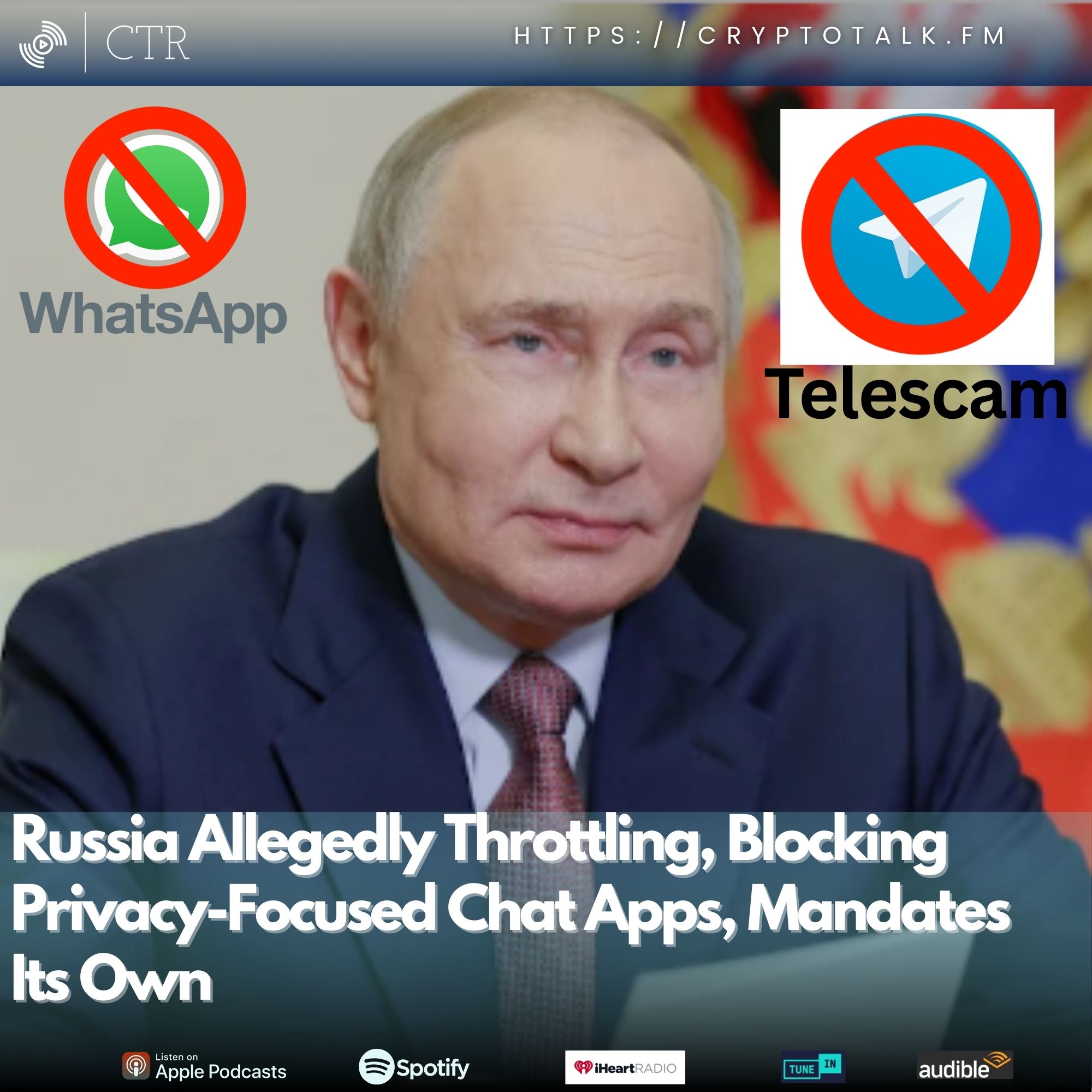
Russia very recently started doing a crackdown on some of these tools, claiming that they're largely non compliant. One of those of course, is Telescam, which was being throttled, not outright blocked, but being throttled. And this happened about a week ago.
WhatsApp was completely blocked, just dominating it out. And allegedly, and I didn't know this, but in Russia when they issue sell, when you buy cell phone, they mandate this tool called MAX to be installed, has to be pre installed on every device that's sold in Russia. And people think it's just state sponsored surveillance is what it is. You're giving it to us under the auspice, look it up, that it's private chat communication, but it just allows the deep state to monitor all communications and there's no option for us to have private communications.
Now people have often wondered why is it that we can't seem to settle on one framework that is the most secure? I'll, I'll send you back in time a little bit.
There used to be, and I believe it still exists, but there used to be a technology called irc, Internet Relay Chat.
I worked with a guy, this is back when I was like 18, I worked with a guy and I built the front end. He, he built the backend to where I was able to build basically just a web page based IRC client, or excuse me, ICQ client, because IRC at the time required resources server.
And icq, which was a different method of communication, was much simpler, much lighter, largely resistant to any sort of monitoring or oversight.
But IRC was more ubiquitous, more people used it, it was more widespread, it was more popular, easier to use than ICQ was, even though ICQ was the dominant for the purposes of these private communications. So when we did this web based ICQ application, we couldn't get any traction on it. Even though it was superior for the purposes of privacy and security.
IRC ultimately won out.
And then IRC was basically superseded by, you know, AOL Instant Messenger, Yahoo Messenger, MSN messenger, and so on. And then other chat tools would dominate. And of course now people have ran away from these chat tools.
The point though is that people have done analysis to try to understand why is it that it seems like we're repeating history where we can't settle on these tools that we know are superior.
And the question is, are they really superior? And the three for the iron triangle that I described relative to these tools has to do with decentralization, privacy and usability.
Now there's a kind of a running gag in security, any security, which is that if the more secure something is, the less convenient it might must be. Biometrics is every single provider's way of trying to be convenient but still be secure. The flaw of that, of course, is this. You know, crooked cop can basically just grab your finger, force you to unlock your phone, and illegally access all the stuff before your attorney shows up. It's not safer than a password, which you can just do plausible deniability and claim you don't remember the password. They can't. How can they prove that you do or don't remember it? Right? Password is the ultimate insecurity. The flaw of passwords is it's hard for people to remember them the more complex that they are. And many services require increased complexity of the password. This is what we're talking about in terms of usability, general usability.
So a lot of these tools lean very heavily into the idea of privacy.
Telescam touts, look it up, that it's private, but it's not really inherently private.
Most of it is accessible through law enforcement. You'd have to do a secret chat in order to hide your tracks on stuff. WhatsApp is wide open, you can eat. Law enforcement can easily get stuff. The Nancy Guthrie, they were able to recover footage even though she doesn't have a subscription where it should be recorded to the cloud, but it was still available because even though they tell you it's not there, it actually is there. This goes to the privacy aspect. They'll tell you about privacy, but that doesn't mean that there's true privacy.
So the bottom line is that this outcry over what Russia's done falls on deaf ears because those people refuse to jump to other tools because they lack usability, they're not user friendly, they're not easy, easy to use because they're not meant to be. When you need to have that level of control and safety and privacy and security, it's going to be a bit tedious to use that tool. So they're forced to use like VPNs, and some VPNs are blocked. There's all sorts of things to Prevent use of VPNs, not just in Russia, but everywhere else.
What am I going? Where am I getting at? Well, remember that cryptocurrency has pitched the idea of decentralization and you've seen tons of tools come and go that have touted the idea that cryptocurrency can assist. Blockchain technology can assist in creating some of these tools that are designed to help simplify this process and solve it. Phantom project is one that I remember from the distant past that believes had shielded a point and turned out to be essentially a rug pool. Because I didn't see anything from it at that time, it didn't seem like it was going to solve the problem.
This is a problem that nobody has solved. There's not been a tool that helps assure all three of these things.
Certainly text messages don't. And yet people have YOLO'd into SMS messages as they refer to, and they do not assure your privacy. They might be easy to use, but they do not assure your privacy. The damn sure ain't centralized, but you have people YOLO into them and then of course those are discoverable. When you get to a court case, then people say, well, don't commit crime just because a corrupt, a crooked cop pulls you in. Just because you end up in front of a judge doesn't necessarily mean you committed a crime. So that's the fallacy is that some people don't know that the criminal justice system is not designed to protect you. It's designed to make headlines so you could be caught in a situation that you had nothing to do with and then all your stuff has to be breached in order for them to try to disprove that you're guilty. It is truly guilty until proven innocent. That's truly what the system is.
So this, the search for these kinds of tools, is that because some don't understand? Well, why do you care about anonymity? Why do you care about privacy? Why do you care about security if you're not a criminal? Because it doesn't take a criminal to want to be cognizant. Look it up about your own privacy and safety and security. Some people just want to do it because they don't trust the system.
And that's paranoia or otherwise. That's just why, bottom line, Russia seems to think there's something to it, because why else would you do a crackdown? And then, of course, don't get me started on the, on my beef about Telescam. I've said it before, it's there to, to scam you, it's there to rip you off. I'm glad to see that there's some history trail underneath it. But all these young cats still fall for those Telescam based traps, and they will continue.
That's why crypto cannot get out of the hole that it's in because there's too many young people in it that don't understand. And they're not, they've not been taught about the dangers of tools like Telescam. All the cryptos tell them to go there. They don't. These young people don't know any better. They don't understand.
All they're doing is trapping themselves and they're not gonna be able to get out anytime soon.
I wish it were a better world. I don't think we're gonna get there anytime in my lifetime.
My remaining topic is the Clarity act, which of course lacks clarity. I shouldn't say it lacks clarity. It certainly has clarity, but it's clarity that the banking system does not appreciate.
Many people have said that the largest hang up at this point is around yields.
Yields, of course, is you earning based on you staking in terms of crypto.
And the equivalent, the rough equivalent, of course, is you depositing in a bank account to earn interest on your deposits.
And I gave a breakdown in a previous episode of Crypto Talk fm. But bottom line, you may not realize that the bank, when you deposit your funds, they are using your money for all sorts of stuff. They're using it for investments, they're using it for lending. Your money is used, and the interest that they pay you is kind of the way that they compensate you for that benefit. I would remind many people that those percentages Used to be in like the 5% range, where now it's like sometimes 0.5 or 1. It's low.
It's low because of the inflation aspect mainly, number one, to a loss of competition with all the banks failing and being absorbed.
Three, there's a saturation effect.
When there were less people that had their funds deposited in the banks, they had to entice more people to get in.
So because they had to entice more people to get in, it forced them to offer rates that they normally would not have been able to justify over time. They have to hit the point. Saturation. Because there was a scheme.
The scheme was, and some may remember this, there was a time when your paycheck was a physical check handed to you and direct deposit was an option. They gave it to you as an option, wasn't required. You could choose I still want my physical check or I want this direct deposit. And they sold you. That was more convenient because your funds are right in your bank account.
However, not everybody had a bank account because not everybody could qualify for one because the system is rigged against you. There's a lot of sketchy business that goes around the approval for bank accounts. Some of that lightened up when Washington Mutual, which is defunct, came around and started dropping some of those barriers, but they no longer exist. Fintech banking kind of took over, but the lack of branches holds it back. Some people swear they don't need branches. I assure you, if you don't have a branch, you're going to be suffering with a loss of Internet access. This is just what I'm saying. Cash is king, period, point blank.
But it all circles back again to this idea of yields. Savings accounts and interest on the savings accounts and interest on CDs significantly dwindled because of saturation. When they convinced people to go all in to where companies started forcing direct deposit and basically forcing everybody to have an account, they created a saturation when everybody got on accounts.
Now there's no reason to offer significant rates to people because there's too many people. They would be able to afford it. They can't make any money. Banks start to make a profit of some kind, some way, which is why they use your funds to invest in stuff. The bottom line, though, the banks are worried. They're worried that by having these yields on stable coins, it's going to harm their deposits. Because if there are people that only put their money in the bank for the purposes of the interest, say, savings accounts, why would I bother doing that for a 0.5% rate when this stable coin, which is paired to the same US dollar, is offering me 5% on the same amount of money, there'd be no logic. This is what's holding up the banks. They don't want you to have yields in, in that amount. They don't want you to have yields at all on the stable coins. And the primary reason is they are worried about the gutting of the deposits. Now, instead of them competing, which is what the government should encourage, they're saying this needs to be stripped out of there and it needs to be a level playing field. At worst, they could not offer more than what the bank would offer. Well, then there's no logical reason to do it.
Because if it's the exact same rate, it's actually harder in crypto because of the KYL and all the garbage that goes along with it. It completely removes the main incentive for doing it for an investor.
Where's this going to go? Nobody knows. They think that the yield is going to be stripped out of the bill before it goes forward or be completely killed, meaning it won't be worth doing it. Similar to what happened with the Federal Family Education Loan program when they essentially gutted the program by making it not profitable anymore. They just, it still exists, but it's not profitable. There's no reason to do it. They killed the financial incentive. I suspect something similar would happen. Have to happen here. All driven by the banking industry. The banking industry wants to hold that back. Which is why I said I'm not a fan of trying to make it like the banking industry, crypto, I mean, because all this is exactly what I said was going to happen. They're going to find it to be a threat at a point and then throttle it because the government is going to bow down to the banks. Remember, too big to fail. We're right back where we started again.
Now, if the banks were smart, and I stress this, if the banks were smart, they would actually embrace those yields. They would embrace that kind of concept. You're like, why? Because think about it.
If more people adopt stablecoins and the yields are allowed to be whatever they need to be and the banks stay out of the way, the bank can offer their own version of a stablecoin and control their own yield. Compete on those grounds because it's cheaper for them to offer yields on the stable coin than it is on the actual cash assets.
The stable coins can then be used against the larger crypto market, in this case Bitcoin, Ethereum, etc.
And you can generate way more money than you're able to do on the banking regular fiat side. On the fiat side, they might be invested in like real estate. Real estate has bubbles, crypto has bubbles. There's no different. Except that real estate's bubbles are largely man controlled. We are the ones that make the bubble happen. When we lessen regulations, when we tighten regulations, we harm the market and we can't seem to hit that middle ground. So we wait until we're in a crisis of some kind and then we drop the regs to get out of the crisis, but. And then we cause another crisis. They can't rely on the fiat side's stability anymore like they could have before. That rhymes.
But on the cryptocurrency side, the bubble is largely predictable. If you pair to bitcoin, you understand it's going to go in those peaks and valleys, but you can leverage those profit opportunities, make way more money than you could have before. It's just another investment vehicle. The banks don't see it that way. The banks see a threat to their core business because their core business has not evolved. How do we get past this impasse? In my lens, you need a fintech. Who says I'm just going to do that. I'm going to create a stable coin. I'm going to offer that yield of whatever the f I choose because it's my asset and see how it works and market it to the masses. As this is a mar stable coin, this is what we're doing on it. You'd have to do that.
I don't know why the fintechs have not. I know Stripe talked about doing it, but it never came to fruition, far as I could tell. But to me as a fintech should just step up and compete.
Then what? What do you have to lose really? You don't have anything to lose. You already have. You already have disrupted the banking industry by being a fintech. There are regs specifically for you. Western Union has already disrupted. They could do a stable coin very easy. They're already using blockchain to help some of their transfers. It just seems like they're afraid. They're waiting for these acts to provide that direct message and they're letting the bank steer the ship. And that's not going to go right. Right. In my opinion.
Long term though, the Clarity act is holding stuff back. People are nervous and then the bitcoin dumps and things and that may cause a little bit more. If it does go 29, that'd be a huge thing and maybe some urgency on the p on the part of the bill readers what the time will tell. Let's see how this all goes.
Sam.