[00:00:01] Welcome to Crypto Talk Radio, the podcast for everyday investors like you. Visit us on the
[email protected] and now here's your host, Leister.
[00:00:13] Thank you for that, Bailey. And welcome everybody out there in Crypto Talk radio
[email protected].
[00:00:30] Late in the evening, she's wondering what crypto to buy.
[00:00:40] She opens her wallet, taps the connect on the side and then she'll ask me, is this one all right?
[00:00:58] And I said, no, biatch. That crypto will scam you tonight.
[00:01:17] Clarity. Such a simple term with such a diverse definition. CryptoTalk FM. My name is Leister. I am your host.
[00:01:25] Interesting. I've not spoken to some of you since last year.
[00:01:29] Welcome, welcome back. Hopefully you had a good holiday time off.
[00:01:35] Unfortunately, there are some. The snowflakes, there's a lot of snowflakes still.
[00:01:40] And this idiot in their vehicle that did like a triple U turn, I don't know what they're doing. Then they pulled into the commercial and then they did a zigzag 8 shape coming out. And then they, then they finally parked on the street.
[00:01:55] Nowhere close to where I think they're going. But I'm not really sure because it doesn't look like they know what they're doing either because there's like a school down the road and there's some sort of parent whatever going on and they're bringing their kids, but he's nowhere close to the school and he did this weird eight shaped thing in the middle of the road. This is a busy through fair and I didn't know what he was doing.
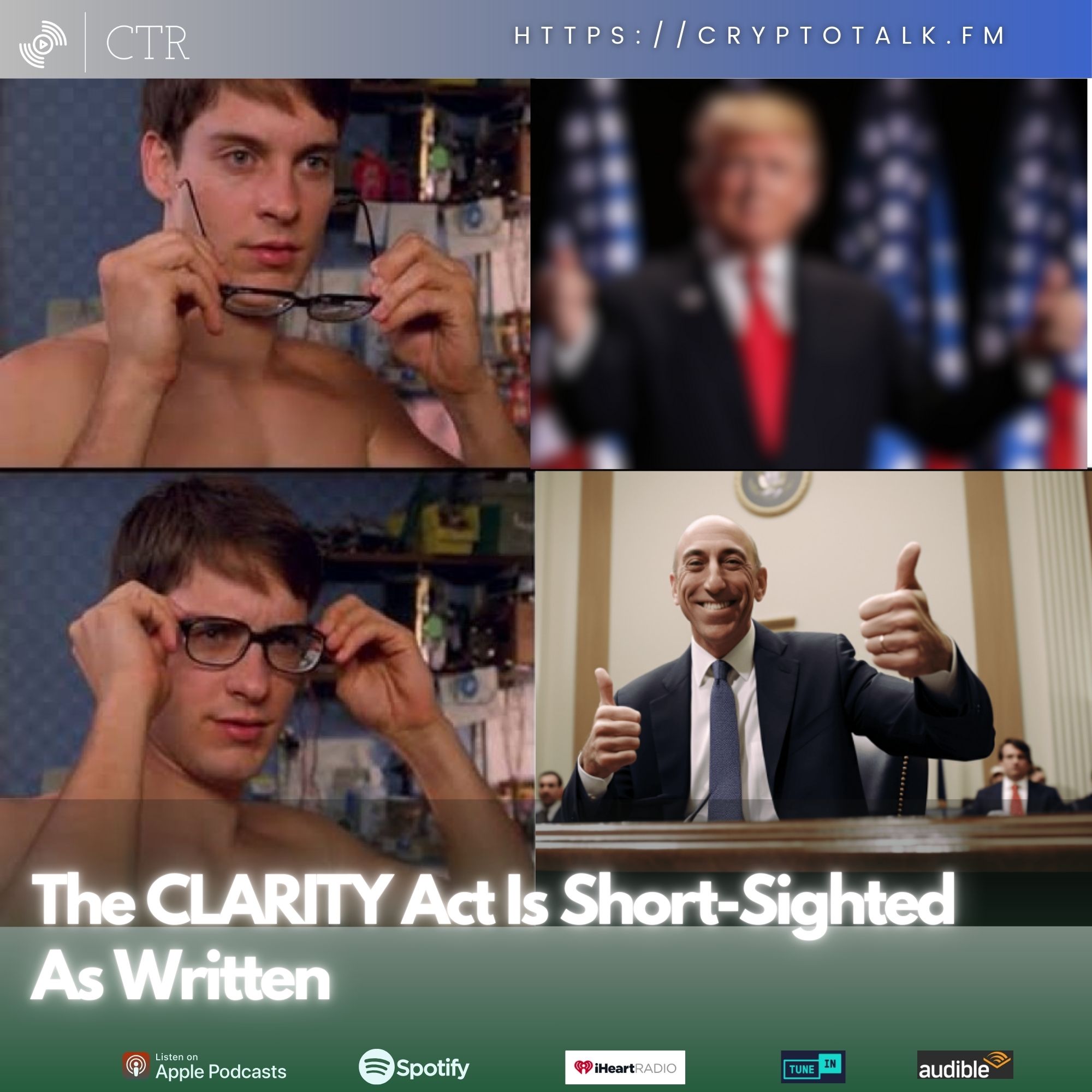
[00:02:15] So it occurred to me that I had not, as somebody brought up, it occurred to me I had not spoken about the clarity act or the genius act. However, when I thought it through, there is a reason that I did not speak about clarity or genius and it's simply because I felt like these are just trying to placate the industry.
[00:02:42] Well, do something. You know, there's no real thought heavy thought. I think behind them now when I say no real heavy thought, I don't suggest that nothing was done or that people didn't try.
[00:02:58] I'm saying that I feel that both missed the point and I speculate.
[00:03:06] And just for some that don't seem to understand this, I have every right to speculate and share my opinion about what I think on something.
[00:03:14] You as listener can listen to what my point is and my argument and form your own opinion whether it agrees or not. I don't expect you to group think I share the opinion and put it out there, irrespective of some people who don't want me to do that.
[00:03:30] So first, let me summarize Genius act at a basic level. I'm not going to dig into genius. I'm going to dig into clarity, because Genius has already been passed and signed by the President.
[00:03:42] These are two parts. Genius was designed to get some framework around stable coins. This is why you might have heard news articles talking about banks getting on board with issuing stablecoins. And so it opened the doors for a connection, a legal connection between stable coins and fiat.
[00:04:01] And it allowed oversight, clear oversight, instead of the Gensler era of regulation by enforcement.
[00:04:10] The Clarity act then gets written up and people are celebrating. It passes the House reasonably smooth, gets to the Senate Banking Committee, let me be clear.
[00:04:21] And they start to butcher it.
[00:04:24] When I dug into it, and I didn't go deep until recently, but when I dug into it, it got me to think that, yeah, they're just, they're just going through the motions. This is not something where they fully understand the appeal. And you're going to end up, in my opinion, with basically an offshoot of the stock market. By the time if, if this goes the way they've gotten it written, it's the same as the stock market. You know, the. Well, there's certain hours of trading, and then if it starts to have too much volatility, there needs to be halting. And. And if we have a suspicion, because your last name is Akmet, that we need to block the transaction and take your money, that's essentially the kind of things I see in there.
[00:05:09] It occurred to me that certain YouTubers are. They're fixated on the. Well, SEC is going to be out of that and it's going to be CFTC and it's going to be treated as commodity. So we're not going to get sued. And if you do this, I'm going to break that down.
[00:05:24] But it feels like some of them are not reading between the lines of what this really says, at least from my interpretation of said, I am highly concerned with what it is.
[00:05:37] So at the basic level, the Clarity act is intended to do one main thing, which is to better categorize assets, digital assets, as well as to better identify which of the two agencies in the US have the oversight.
[00:05:56] Cftc, which traditionally deals with commodities, and the sec, which traditionally deals with securities.
[00:06:04] The gray cloud has been what is a security? And if you heard Gary Gensler, that's security. That's security. They have security. He called Everything a security other than Bitcoin. He straight said this people have speculated years over.
[00:06:19] The Howie test, which is decades old.
[00:06:23] Being used against cryptocurrency was an attempt to suppress cryptocurrency's rise.
[00:06:30] It was an attempt to suppress popularity.
[00:06:33] It didn't work for 2020 and 2021 when we had crazy rises. However, the enforcement wasn't nearly as aggress aggressive as it then later became, which then stymied some of the runs. Then when Gensler's on the way out, we get more runs.
[00:06:52] This tells us that the industry is kind of waiting in the wings and they're not sure what's really going to happen. Exchanges that jump out of the United States allegedly due to the lack of regulatory clarity. Maybe, maybe not.
[00:07:06] Kraken, crypto.com. i think they're a scam. But the point is, I'm using Kraken as an example. Kraken has kind of gone feet first in all the way in and said, bring it. We want. Business. We want. And they've improved and they've enhanced. They've done all sorts of good stuff, I think, to support this. Whereas Coinbase started good and then started to regress after the SEC went after them.
[00:07:31] I said crypto.com is a scam. I don't literally mean a scam. I mean they're a scammy organization. I don't think very highly of them.
[00:07:39] Robinhood is a joke. They basically said, well, if you're in this state, you can. In this state, you can't. In this state, the dude to do.
[00:07:45] So I don't think highly of them. By the way, they canceled my cash card that it took me months to just get the fucking thing activated. So, yes, I do have somewhat of a bias against Robin Hood because they made it way too difficult to transact business with them unless you were in certain locations. Then they changed the terms of their cash card for no logical reason other than they just felt like doing it to encourage this other service. I think it's Gold.
[00:08:12] That's a paid service. That's no different than Citigold from Citibank where you pay a monthly fee for the privilege of. And in Citibank's case, you got true value out of it. They gave you a line of credit straight out with no extra application. You got to do money orders, free cashiers checks free, a number of wires free. Like it was there. It's like it's catering to certain service customers that needed those features. Robinhood, Gold, all they're doing is taking what used to be free and making you pay for it. So I don't think highly of Robin Hood. I digress.
[00:08:50] The Clarity act then classifies these in categories that are designed to be clearer.
[00:08:58] But it takes it a step further by then identifying certain points in time that a certain category applies for a certain asset class.
[00:09:08] So the first, every thing.
[00:09:11] This gets confusing, but everything's going to fit into number one, which is digital commodity.
[00:09:18] Their definition of digital commodity to me is somebody that didn't understand and I get what they were trying to do, but I think it just muddied the waters. At the end of the day, they say it is a digital commodity if it's ultimately linked to a blockchain.
[00:09:34] So that tells you any sort of. And it's talking about assets. When I say anything, an asset that's linked to a blockchain, well, that's pretty broad, right.
[00:09:44] However, they later go on to exclude securities.
[00:09:49] Well, that gets ambiguous, right, Because a security is something that the SEC creates their own definition for.
[00:09:57] We'll talk about that in a second. Derivatives. So derivatives trading, you know, ETFs and that sort of thing. I think that makes sense, right? Because these can be their packages of assets. The assets are tied to blockchain, but the derivative is not blockchain driven. It is not. It is influenced by the success of the blockchain, but the derivative itself is not connected to blockchain activities. Which means very simply and I. This is why I think they didn't think it through.
[00:10:30] The only time you could have strong derivatives in play is for a mature chain.
[00:10:38] So we talk about Salanas, right? We talk about Bitcoins, we talk about Ethereum potential for xrp more.
[00:10:45] These, these are mature ones.
[00:10:47] This as defined, creates a blockade for any new one to come after some chain that just shows up to later become eligible for derivatives trading. This creates a blockade. It doesn't completely stop it. I'm saying it creates a hindrance. Look it up. So again, I understand where they're going with it.
[00:11:11] They're trying to create some sort of current state snapshot right now. These are the assets we trust.
[00:11:18] Okay, let's codify. Look it up. These in a framework that we're cool with, as in we'll define them and exclude them from digital commodities. But if you're not mature yet, we're not going to allow the derivative. Thus you're going to fall into this other category of digital commodity, provided it's not also a security, which is an arbitrary definition right now. It also Excludes stablecoins.
[00:11:46] However, the definition of stablecoin has been changed.
[00:11:50] In current cryptocurrency, you have algorithmic stablecoins.
[00:11:56] You have pegged fiat stablecoins in their definition of a stablecoin under these regs.
[00:12:04] However, they're saying however you do it, you need to peg to a trusted asset. So when we say trusted asset, they're essentially talking fiat and there are exclusions for foreign based assets. So what they're essentially doing is they're saying, if you're going to do the stablecoin and be governed under this regulatory framework, essentially you need to peg to our US dollar.
[00:12:31] Now consider what that means.
[00:12:33] The increase in inflation of the US dollar and its devaluation over time pegged to stable coins means that you are not getting away from the impacts of inflation that fiat has wrought. Look it up. Look it up.
[00:12:51] And this was purposely written. It was purposely written to avoid decoupling from inflation by way of stable assets.
[00:13:01] The banks as the impetus behind this. The banks are sitting on cash, they're dependent on cash.
[00:13:10] So in order for the government to be okay with them getting into crypto, they still have to be beholden to cash.
[00:13:17] I can envision, and this is my opinion, a world where when you're trying to do a transaction that is for cryptocurrency, you are compelled to use a certain type of stable asset pegged to whatever fiat, such that you cannot benefit directly from a non inflated value or price.
[00:13:41] And because of the transaction and the nature of it being connected to fiat, it's no different than you doing a straight cash transaction with devalued assets.
[00:13:53] I know that sounds kind of complex, but follow, if the bank gets in cryptocurrency and they tie it to fiat, it means that the price that they have to offer would have to run lockstep with that inflated value or artificial value.
[00:14:15] So I'm suggesting, and it's only a suggestion, that it would not be financially advantageous to transact through the banks because their pricing would have to be lockstep with an inflated value, not a market value.
[00:14:34] Market might be disrupted by the inflation present with the stablecoins connected to the fiat.
[00:14:44] This is all speculation, but what I saw that they are purposely trying to connect stablecoins to existing fiat. Purposely.
[00:14:53] How can you then decouple from inflation? You cannot do if you're connected to an inflated asset, which is the flaw of crypto. If you're connected to an inflated asset, you are connected to inflated values and inflated pricing. And when you do it to the stable coin, which is the main transaction exchange point is through a stablecoin, you're essentially tethering, no pun intended, your cryptocurrency to an inflated value. If my speculation is correct, and I can't say that it is, the second category is called a investment contract. This is originated from what the SEC described that cryptocurrency was, that qualified it as a security.
[00:15:38] The idea that it is an investment contract. I am investing money with an expectation of a return of value.
[00:15:46] And anytime that you are issuing a cryptocurrency pegged to value in this regard, that it constitutes an investment contract. So now they're defining in the future state an investment contract.
[00:16:01] They are accounting for cryptocurrencies. However, what they're saying now is this has to be something that is sold for the purposes of raising capital. So now you're talking specifically around like an ICO or an Ito something where you're generating a pre sale, you're generating for the purposes of getting money from people. And so that initial transaction is an investment contract because the only reason somebody would buy in the presale is the expectation of a return on their investment.
[00:16:37] It goes further to state once that token has been purchased by a person, if the purchaser then turns around and resells it on the secondary market, that resell does not qualify as an investment contract. It is a secondary market routine transaction, no different than any other commodity.
[00:17:00] I actually support this. I support the idea because what it does is it puts the burden on the token issuer. It puts the burden on that project. When you're putting a pre sell out there, the moment you do that, you are creating an investment contract. You are therefore subject to regulatory scrutiny and that's protection for the people buying in the pre sale. I have no problem with that. I, I have no problem with it being temporary because once again, once the investment is resolved, meaning I sell that asset to somebody else, once I've sold it, that person's off the hook. The original issuer is off the hook because there's no longer a contract implied contract between the two.
[00:17:44] The other part of this one, which I do somewhat like is it expects that the, this is all part of an actual product.
[00:17:55] So if you have a pre sale where they're telling you it's going to be a blockchain, there's going to be a blockchain for this. Da, da.
[00:18:02] They're saying that all of this is contingent on the maturity prospect.
[00:18:08] So if you get to a point, if you say I'm going to do a pre sale, I'm going to give you a blockchain. And I say, and this goes to claims, if I say the blockchain is going to do xyz, it'll do dapps, it'll do games, it'll do all these things and you make it do that.
[00:18:25] So you've matured the blockchain, you delivered on these projects and products.
[00:18:31] Then they're saying we could remove the security designation from that token that backed it because now it created a utility where the token now or coin can now have val its own value, its own intrinsic value, as opposed to being beholden to promises that may or may not fly. So if you picture it, it's saying that for the duration of this, your lofty promises, your BS promises and all these things you say you're going to do in a pre sale and you want my money, you are subject to scrutiny by the government and you must deliver. And if you don't deliver, there's all sorts of penalties and criminal penalties and everything else. You're like, this is perfect, right?
[00:19:12] So why then are you against it? Follow me, I'm not done. The third category, they call it specifically a permitted payment stablecoin.
[00:19:23] They're stablecoins and some stablecoins sole purpose in life is to enable a transaction, enable a transfer, enable an exchange. It's not for the purposes of direct payment issuance.
[00:19:38] For example, if you wanted to as payroll pay your staff in stable assets, certain stable coins you would not do that with. You're using it to benefit the chain, let's say, and the stability of the value of the chain. Or you're using it locked into liquidity pools to support transfers and exchanges. A permitted payment stablecoin in their definition specifically is for settling payment transactions.
[00:20:04] So you can think Western Union, right now, Western Union takes money in, they essentially send a ping to another bank elsewhere that says, no, you're good, go ahead and give that person 500 bucks on the other side, they take a fee from your outbound, they take it, they take their cut, they send a ping saying it's okay, go ahead and do that. And then they send money to that third entity where on the other side and then the person go pick up the money. In this case, you're allowed to use a permitted payment stablecoin to do the issuance using the stablecoin in the blockchain, which takes out at least two layers of the process. You no longer have to worry about bank reconciliation on two sides. The blockchain already Reconciles it for you. It already has the ledger for you. All you have to worry about is the cash out, which is the conversion to fiat piece. That's why it's a settlement. So you're settling money off of this value, off of this coin value.
[00:21:06] They're also saying it must be on a national currency. So again they're essentially assuming United States dollar in the way it's written because they do say it has to be, you know, it's subject to US scrutiny, which only the US dollar would be. And it has to be repurchaseable for a fixed amount of monetary value, meaning that the stable. Right. It cannot fluctuate. So at that point you could not really do an algorithmic because an algorithmic constant fluctuates even. Even as you trade it tether it fluctuates. You can see it fluctuate. It's not a significant fluctuation and in most transactions it's not of significance to where it matters, but it still fluctuates it in what they're defining. They're defining a certain type of stablecoin that is purposely built again, lockstep with fiat.
[00:21:57] So lockstep with fiat. It's however much cash you have available so that if we had to liquidate you, we know that we're getting 100% of the money that's part of this process.
[00:22:09] Most are celebrating the separation of CFTC and SEC because in the way this classifies coming back to this investment contract business, you have stages.
[00:22:20] So stage one, I have an idea. I want to launch a cryptocurrency and it's going to be on the Ethereum chain.
[00:22:28] I'm not going to do a pre sale. It's going to be a fair launch token under that situation as written. If it's just a regular token, fair market value, it's not peg stable. There's no pre sale.
[00:22:42] I'm not promising a blockchain, I'm not promising a product. So you can even think memes right under the way this is written, it's a digital commodity because it's tied to a blockchain. It would not be an investment contract because there is no expectation. You're not investing to get something. It's just a token that's out there under that the CFTC would regulate it as a commodity.
[00:23:05] Take a different project. This project says we are going to launch on Ethereum later. We're going to give you a blockchain of our own. We're going to go straight our own blockchain. But Step one, we're going to go on Ethereum. We're doing a pre sale now to generate funds for the blockchain.
[00:23:27] On the way it's written that is absolutely digital commodity. The moment it launches.
[00:23:32] The moment they launch a pre sale before they have any product.
[00:23:37] SEC steps in and says now we're going to watch and we're the watchdogs to make sure that what you're doing because it's a security until and it's an investment contract until you deliver what you said, you're making these promises. We're going to watch what promises you make, we're going to watch what claims you make. And we are the oversight on this one.
[00:23:57] If they don't launch a blockchain, at least as written, that issuer is criminally liable. We're going to go after them because they did not launch what they said.
[00:24:07] Here's now you asked why are you so against it?
[00:24:11] If we understand cryptocurrency issuance and you can look at the data stats, the vast majority of issuance are from people that are not in the United States.
[00:24:22] If we accept that stat that the vast majority of people not in the United States they're not going to be subject to to this scrutiny because they cannot be.
[00:24:32] They can try to enforce it but if it's somebody out of Vietnam, that person is not going to be subject to US scrutiny period.
[00:24:39] So it doesn't solve the underlying problem.
[00:24:43] It simply doesn't.
[00:24:45] It does allow central exchanges to be more confident transacting because those are largely secondary markets. If the exchange is smart enough to build their web to separate their because they have like launch pads and pre sale things. All you have to do is build your web to create a separate area for your launch pads and pre sales and everything else.
[00:25:12] Lock it behind a login.
[00:25:15] After you log in, test where they're coming from by way of the address for the billing for them withdrawing assets. So if they want to withdraw assets they got to give them a bank account.
[00:25:27] You ask where the bank is, you can tell from the transit number, routing number.
[00:25:32] The transit number tells them where the bank is. You go off where the bank is and you say your bank is in the US As a result of money going there.
[00:25:45] We're going to let you go into this pre sale thing but we're to give you a big box right up front that says transacting these is investment contracts. These are considered securities in your jurisdiction.
[00:25:58] You're on the hook to make sure that you get the product that you say we're out of it. We don't control the integrity of the pre sale. We're a launchpad. We just put it out there.
[00:26:10] The reason that most exchanges won't bother doing that is because it means they got to manage different code for their site specific to the United States.
[00:26:19] They just want to have a free for all because the exchanges are profit motivated. They want to make as much money as possible.
[00:26:25] They're not in the business of keeping people safe. For those that don't know Saitama slash side of chain Saitama slash side of chain was documented working with lbank to and I'll talk about this as I wrap up working with L Bank to wash trade.
[00:26:43] LBank was telling introduced these people and telling them go here. These people take care of you. Lbank didn't do the wash trading. The representative, the employee, individual employee. So the L Bank employee makes the introduction to those that were doing the wash trading that ultimately got these guys caught.
[00:27:05] LBANK looked the other way.
[00:27:07] What I'm saying is lbank is profit motivated. Finance is profit motivated. They all are profit motivated. They want to make money. They don't want to lock down down. They don't want to restrict. That's the last thing they want to do. That's why like Gate IO Gate IO used to be open to us then they got out because they didn't want to do all of the rigor and the regulatory scrutiny that was there. Many exchanges won't want to do it. Ones that don't do those things probably won't care. Like I expect that Kraken will be as if nothing changed really except for a couple more forms Baby Coinbase. I think they're going to lock stuff down if only because they opened up to a bunch of garbage tokens is my theory. I don't know but I think they will. Robin Hood. I think they're gonna lock stuff down because of the way they work. These are theories. I don't know for sure.
[00:27:55] Lastly, under the Clarity act there are explicit prohibitions. There are things that must happen and then there are things that must not happen. Critically speaking, I'm not going to go through all of the all of these. I'm going to go through the most important, the most critical, that I saw.
[00:28:15] So what must happen? Absolutely defi activities being excluded. So when we say defi activities, what are we talking about? This is basically excluding and safe havening node operators, validators, you know, software providers that just make the thing run like there's not something where it's a a risk that it could take money from you. It is. These are just facilitators of a blockchain. They're facilitators of transactions, they're facilitators of defi activities. In order to make the thing run, these have to be there. They're excluded because one of the fears was that a node operator or a validator would be subject to scrutiny. Because in the Gensler era it was considered that these. It's a security. It's a security. And there was an enforcement action on mining operations. At a point later it got revoked. The point is this is trying to lock down that these are excluded from this regulatory scrutiny that we're talking about.
[00:29:15] I have no problem with that specifically.
[00:29:19] What it says though is although there's this exemption, that doesn't mean that the CFTC and the SEC can't do for their own reasons anti fraud mechanisms, anti manipulation mechanisms, false reporting mechanisms. So when you think of anti fraud, anti fraud implies monitoring. Monitoring requires data collection and data disclosures that we don't currently have across the board. That works fine if it's a central exchange, but when you're talking like a uniswap they don't collect enough information for to make this happen they would have to start doing.
[00:29:58] If we talk about anti manipulation in the stock market side I talked about the halting. They do halting to stop excessive volatility because they're trying to prevent manipulation of the price. That's what this implies. In order to make that happen you would have to require that the chain have things like pause mechanisms and you know, the ability to whitelist, blacklist etc. You'd have to do that. You have to force it. Well to have that then you have to give the keys to the government to let them do it because you wouldn't have a central authority if it's defi like this is putting it together of what it's implying. I don't know if it's true. I'm saying that's what it implies and people have to read between what they're saying to understand how would you make anti manipulation happen other than halting? It's the only way that you could halting would be freezes and blocks and bands and all that other whitelist blacklists, balance sheet clarity, custody sheet clarity. Well, what is custody? Custody is your keys. You hold the keys.
[00:31:02] This connects in my opinion to the IRS in one key way. We already have the requirement of reporting cryptocurrency behaviors to the irs.
[00:31:10] Right now it applies largely to the central exchanges.
[00:31:13] Let's take a world where in this case they say all cryptocurrency assets, all of them that fit any of these categories to basically any and all of them, have to be reported. Custody has to be reported. That violates again, privacy. The whole point is why should you have to know how many assets I'm sitting on at any given time? Why do you care? They care because if you're connecting it ultimately to fiat, they want to have oversight or over the connection back to a fiat world, they want to have control over how much fiat you can take from the system.
[00:31:48] That's how I interpret it. Whether that's true or not, that's how I interpret that in what I see.
[00:31:55] So two points left. One, and this is my beef too, when I describe the idea that everything that's blockchain essentially is a digital commodity and it starts that way, CFTC and then goes to an ico, becomes an investment contract and then after it's done there, it goes back to being a commodity. It's trade on secondary market. Sounds good, right? But as written, that does not stop somebody who's at a basic level of intelligence saying, okay, I'm going to create the token, I'm not going to advertise it yet.
[00:32:33] I'm not going to advertise a pre sale per se.
[00:32:37] I'm going to create the token, I'm going to mint the tokens out.
[00:32:42] I'm going to tell the people that I'm going to launch said token on a certain date, on the date that I launch it, I make the tokens available for sale.
[00:32:54] That's a secondary market transaction. But it's not because the owner is the one doing the sale. It's a, it's a one level first, it's not resold.
[00:33:06] If the owner issues the tokens in their own contract and then they go buy them and then they sell them, it's now become a secondary market transaction which circumvents the SEC really easy.
[00:33:19] And I agree with that risk because of the way it's worded. You're, you're making the assumption of ethical behaviors that has not been, it has not been evident in cryptocurrency, at least not to my knowledge. It has not been.
[00:33:34] The other one is an explicit ban on WASH trading.
[00:33:38] If you don't know what WASH trading is, you'd be surprised to understand that the vast majority of, if not all, exchanges are aware about WASH trading activities and do nothing about it.
[00:33:51] An example of a WASH trade, if you have Somebody that you partner with and you say, I want you to buy and sell my token at a high velocity.
[00:34:03] You're doing it. And then increase the price each time that you do a transaction. So you offer it for sale at 50 cents, you buy it at 50 cents, you offer it for sale at 60 cents, you buy it at 60 cents, you offer to sell 70, you buy it at 70.
[00:34:19] Sometimes you mix in there, sometimes you sell it a little bit lower so it doesn't come across obvious. And you usually will control how much traffic you're pumping through it because you don't want it to raise flags. Fact, the exchanges will tell your token your traffic is causing red flags. It's too high. It doesn't make any sense. So like if it's a new project, you wouldn't expect to have a million dollars worth of traffic. It doesn't make any sense. However many do.
[00:34:47] Finance is notorious for this.
[00:34:49] Wash trading is you are working either because you're doing it or because somebody else you've worked with is doing it per your request to do so.
[00:34:59] To artificially, artificially inflate the price and create the illusion of a market that's not really there. These are not real people. There's not real interest. You're doing it to get interest.
[00:35:10] It would surprise you to understand the vast majority of cryptos do it that are not the big ones. Bitcoin, Ethereum, Avax. Right.
[00:35:20] So this is trying to ban that. Lock it down.
[00:35:24] If you ban market wash trading, you lock that down. Let's say they do pull that off. If you lock that down, what would you end up with? You would end up with a world where no cryptocurrency can effectively survive, period.
[00:35:41] Unless they are able to produce a product and they are able to market that product outside of the crypto bubble.
[00:35:50] No crypto has done it. None. None have pulled that off. I don't care what you say. World Coin ain't.
[00:35:58] Doesn't count. It's pump and dump. I'm talking real. I'm talking. They show up on TV with their product. It is a product that has nothing to do with the crypto. The product itself is a tangible product. Like if you think of. And this is something I would love to see happen. I'm closing here.
[00:36:14] I would love to see happen. Like ecoflow. I'm a big ecoflow fan. In terms of the products, their support is crap. Their software is garbage. Their firmware strategy sucks. I like the product. I don't like the software. The software is horrible.
[00:36:30] If you could Take what ecoflow has built the their entire ecosystem structure and you connected it to blockchain technology.
[00:36:40] And by way of doing that, using the products right and gathering this data, gathering energy data, gathering location data, because there's all sorts of valuable information using blockchain for that. And you compensate customers with cryptocurrency that is not a stable asset. It's just a cryptocurrency for ecoflow. And that's the compensation we're giving you as a way to thank you that cryptocurrency then has intrinsic value because it can be connected straight to the stock levels of the company without being tied to the stock market.
[00:37:16] It's all about value and all about what the perception of value is for a given entity. If you have a company that has a tangible asset sold on mainstream tv, you're not going to tell a scam, you're not going to, you're not locked in discord. We're talking mainstream product that just happens to have a cryptocurrency associated to it.
[00:37:38] This that we're talking. The prohibition against WASH trading is the only way a cryptocurrency project can thrive because it means you would not be able to do what every one of them do now, which is just talk to a bunch of influencers, tell them to shill the product plan on a future launch, pay tens of thousands of dollars to a wash trader to create artificial pump numbers so I can do a pump and dump graph. You wouldn't be able to do that. You can tell the influencers, the influencers, they're not going to have enough power to influence significant buy in. If they don't see that that price is pumping because the buy tendency is on the green, sharp green. It shouldn't be, but it is.
[00:38:24] Whereas if you tie it to a real product, this is where real world assets I think has a part to play. If you tie it to a real product and you're outside the crypto bubble and you get to the mainstream by way of the product, you're going to have people that just take the tokens and do nothing with them because they see no value in them. If they sit on them because they see no value in them, but they don't do anything with it, you're locking them out of circulation. Locking them out of circulation. If you get the right set token count and this is a balance that nobody's perfected, even Bitcoin, be at the right set token amount and you create that value, it's going to naturally appreciate and take off under this kind of regulatory framework.
[00:39:08] So I say in my mind, as written, I'm not a fan of how this is done because there's too many loopholes, there's too many opportunities for it to be exploited.
[00:39:21] I don't see how you can enforce it on non US issuers who the vast majority of issuers happen to be.
[00:39:29] And I question whether or not it has any teeth.
[00:39:32] Meaning could a regular investor bring any kind of lawsuit against or for this? I don't see that they could.
[00:39:40] Not because they don't have the right to, but because again, if the vast majority are not US issuers A B they're just simple loopholes, it could be that the person's just too smart and we know how slow it is for our government to course correct and write it correctly. I guarantee you it was written this way because they knew the better law would never have passed. It would never have passed the house. The better law. And you're asking yourself what would be a better law? To me it's simple.
[00:40:09] Get rid of kyc, get rid of it. It doesn't solve a problem. All it does is saddle the industry. Get rid of kyc, get rid of aml. Because we're not dealing with money at this point, none of that should apply. Cryptocurrency transactions should be fair game until and unless it goes to fiat. When it goes to fiat, use the existing banking regulations that we already have.
[00:40:34] It's that simple. You don't need to regulate cryptocurrency because cryptocurrency has no set value without fiat any damn way, who cares? Who cares if somebody does a pre sale other than the fact I gave them money? If the pre sale says we don't take credit cards, we don't take debit cards, we don't take stable coins, we'll take any other cryptocurrency that is not a stable asset of any kind or any fiat, there's no money exchanged. If they say all we take is Bitcoin, there's no money exchanged. A commodity is. That's the second market.
[00:41:08] Right?
[00:41:10] That's what that's my issue with it is. I get why they wrote it that way. I think that's to its detriment in my opinion and I question the need to go that aggress. You don't need to. It's simple. Cryptocurrency should have no other regulation until and unless there's a connection to fiat. Once there's a connection to fiat, the regular regulations we already have for fiat should then Kick in. I think it's that simple. A stable coin is only as stable as the ability to sell it for that value. It doesn't matter if a graph says that it's a dollar. If I try to sell the damn thing and only get 50 cents, it's not a stable coin. Right.
[00:41:50] They're reading too much into data floating around the web.
[00:41:54] It doesn't mean shit. Bitcoin, I get it, sailor. Millions of dollars in bitcoin and all that stuff. I promise you, if he was to try to liquidate all his assets, he's not going to get 100% of what he put in it. He won't because that's not the way liquidity works. He can't. He would, he would not be able to full liquidate. He'd have to pull out in sections because the price is going to be going down. That's just the way it is. So I'm just not a fan of regulating something that really has no value without fiat anyway.
[00:42:28] That's right. It's just numbers on a chain. To me.
[00:42:33] I have no problem trying to deal with bad actors, but I understand that the vast majority of bad actors are not in the United States.
[00:42:42] So one way to deal with that, I think without violating privacy, is to simply introduce the cryptocurrency equivalent of the fdic.
[00:42:54] They won't do that because taxpayers don't want to pay for gamblers.
[00:43:00] But that would mitigate it. It's like, okay, we'll let you do it, but we'll put some insurance at least. But we know we can't deal with these bad actors overseas. Taxpayers don't want to pay for that. I get it. I wouldn't, I don't necessarily, but I would rather that than a law that has no teeth that won't do anything to solve the problem.
[00:43:20] In summary and in closing, I understand people's excitement about the Clarity Act. I do.
[00:43:28] I'm not suggesting we need nothing. I'm not suggesting we do nothing.
[00:43:32] I'm saying that it feels like a solution to a non issue. It feels like we're just reacting to people getting ripped off instead of properly understanding when and why they get ripped off.
[00:43:45] If somebody chose to give their credit card to something, yes, there should be some protections. I don't agree that it should be at the detriment of everybody else either.
[00:43:55] If somebody puts a pre sale and some influencer misleads people as to the nature of the pre sale, I think that's, that's going out to the influencer. Not the issuer because we can't know if the issue has the best of intentions or not until the thing's issued. We have to hold them to it, right? They say there's going to be a blockchain. We have to hold them to it. If you feel like their message is strong enough and you believe them enough to give money and I could name at least three projects in this regard. To me that's on the person who gave the money. It wasn't like they forced you. You weren't at gunpoint, you weren't threatened. You chose to based on a message. Somebody sold you a bill of goods. It's no different than Black Lives Matter frankly. Somebody sells you a bill of goods, you give them the money, they go living fat off the hog. That's on you for giving them that money. They might be on the hook for fraud.
[00:44:45] And that's when you go after them is after it's proven they're a fraudster. I'm not a fan of trying to restrict innovation which this feels like it wants to do.
[00:44:56] I understand once again what, what they're trying to do. It just feels like a solution to a non issue.
[00:45:03] So clarity act to me is it does provide clarity. Certainly it does.
[00:45:10] I get the sense that people would not be happy with the clarity that they get compared to the potential cryptocurrency that is.
[00:45:19] Who knows?
[00:45:21] I could get everything I said flat wrong. I could, you know, it could thrive. The industry certainly institutionals will love it because it's regulatory. I'm saying the retail people. I'm saying the retail side does not benefit from this. They don't benefit from halting. Right. They don't benefit from blocks on wash trading. They don't even. They don't benefit from things that suppress interest in something. They don't keep an eye on precious metals if this passes. That's my. That's my spoiler. Keep an eye on precious metals if this passes.
[00:45:53] Because something tells me that there's going to be a run on precious metals of this passes. I don't know why I feel that way. That's how I feel.
[00:46:19] Sam.